Government and Policy
Government to addressurban-rural income gap
By Li Xinzhu and Wang Zhenghua (China Daily)
Updated: 2010-09-11 08:40
 |
Large Medium Small |
SHAOXING, Zhejiang - China will continue to support agriculture by increasing investment, improving the social safety net and making further reforms to bridge the urban-rural divide.
At a two-day Expo forum centering on the topic of economic transformation and urban-rural relations, Zhang Xiaoqiang, vice-minister of the National Development and Reform Commission, mapped out policies aiming to transform the mode of growth of China and promote urban-rural integration.
| ||||


The proposed solutions include stronger investment in agriculture, promoting new towns, enhancing the social safety net and furthering systematic reforms, he said.
Official figures show that the income disparity between rural and urban areas was slightly bridged last year, but was still wide despite attempts by the government to close it.
On average, city residents earned 3.3 times more than those in the rural areas in 2009, while in major countries of the world the ratio is between 1.5 to 1 and 2 to 1.
In 2009, the average income for a rural worker was around 5,150 yuan ($750) - while those in the cities earned 17,180 yuan on average.
The main cause for the widening gap is the low price of agricultural products.
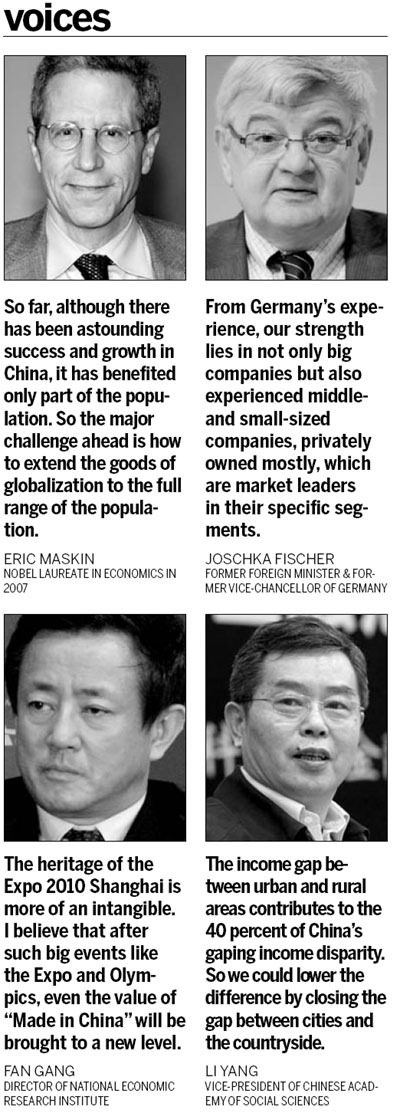
Eric Maskin, professor at US-based Princeton University and the Nobel laureate in economics in 2007, said that the huge income gap between urban and rural residents is a side effect of China's economic miracle.
"Thanks to globalization, the Chinese economy has grown enormously over the last 30 years. However, one unfortunate side effect has been a substantial increase in income inequality," he said.
Li Yang, vice-president of Chinese Academy of Social Sciences, said that the issue of imbalanced income levels between urban and rural areas needs policymakers' extra attention.
"The most important task right now is to adjust the mode of income distribution, and to narrow the gap between the rich and the poor," he said.
James Adams, vice-president of World Bank, said that urban and rural areas have to work together instead of fighting for limited resources.
"The urban-rural relationship is interdependent, which means we have to find the best solution for them to develop together," he said.
The forum, which ended Friday, attracted more than 600 participants, including field experts and government officials from across the world.
Other discussions focused on issues connected to the path of economic transformation and sustainable development, what rural areas received during the economic development of cities and how to realize collaborative development between urban and rural areas.
Related topics such as population mobility and social integration and how small villages survive in a global context were also discussed.