Society
China's soft power set for global audience
By Chen Jie and Liu Wei (China Daily)
Updated: 2010-08-20 06:32
 |
Large Medium Small |
BEIJING - A Chinese company bought the White House? No, it's not in Washington DC, but in Branson, Missouri.
| ||||


The theater opened on July 1 with a show titled Chun Yi: The Legend of Kungfu, which still regularly runs.
It is a small example of Chinese culture going international but there could be many more to come.
China Heaven Creation is one of the 211 companies listed by the Ministry of Culture as key export-oriented culture enterprises.
Other fronts where progress has been made in introducing Chinese culture overseas are film and TV exports, said Zhao Shi, vice-minister of the State Administration of Radio, Film and TV (SARFT), at a news conference on Thursday.
The volume of these exports and related services hit $86.13 million last year, and the overseas revenue generated by Chinese films exceeded $400 million. Both figures marked increases on previous years, she said.
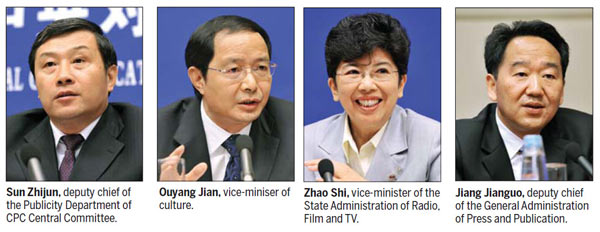
Other officials present at the briefing were: Sun Zhijun, deputy chief of the Publicity Department of the Communist Party of China Central Committee, Ouyang Jian, vice-minister of culture, and Jiang Jianguo, deputy chief of the General Administration of Press and Publication.
In 2009, SARFT hosted 99 Chinese film festivals in 47 foreign countries as well as in Hong Kong, Macao and Taiwan, during which 647 domestic films were screened.
On top of this, 315 Chinese mainland films participated in 119 international film festivals, among which 68 won 80 awards in 26 festivals, according to official figures.
Last year, with the approval of the State Council, the System for the Inter-ministerial Meeting on External Cultural Work, led by the Ministry of Culture, was drafted to integrate resources to launch a platform for Chinese culture, businesses and products to access the international market.
Apart from the 211 national companies and 225 projects awarded by the Ministry of Culture, local cultural sectors also have strived to facilitate the implementation of the "Chinese Culture Going International" strategy.
"Many industries in China have undertaken reform for 30 years, but the culture sector has not developed as an industry until a few years ago. It's hard to sell the current undeveloped culture products abroad but we must find ways to create some key products," said Zheng Wen, director of the culture trade department of the bureau for external cultural relations at the Ministry of Culture.
Zheng said the 2008 Beijing Olympic Games and celebrations marking the 60th anniversary of the founding of New China last year have seen many companies emerge in the entertainment industry, which includes fireworks, design, animation and facility providers. The Ministry of Culture has launched a project called "Team China" to organize these companies to export their work.
One example of this is Mei Shuaiyuan, one of the leading directors of popular domestic open-air shows who is preparing to present his work in Halong Bay, Vietnam.
Meanwhile, State-owned performing arts companies have successfully toured abroad.
Leading companies such as the National Ballet of China, the National Peking Opera Company and the China Philharmonic Orchestra have all garnered international praise.
"Culture represents a country's soft power. China has impressed the world with its booming economy but it's not enough," said Yu Long, artistic director of the China Philharmonic Orchestra. It was listed as one of "top 10 most inspiring orchestras" in 2009 by Gramophone, the world's most influential classical music magazine.
"As Chinese musicians we have a responsibility to export our products to increase the influence of Chinese culture abroad," he said.
Actively exploring the reform of the system is a major task for the publicity and culture sectors, said Sun.
The restructuring of State-owned performing companies with new talent emerging, will deliver unprecedented capability for innovation, Ouyang said.
In the film and TV industries, restructuring has already had results. So far 35 film studios nationwide and 58 TV drama production houses have transformed from State-owned institutions to enterprises.
Private or share-holding film and television productions enterprises have been developing rapidly.
A prime example is the Huayi Brothers, the media group which in July released a domestic disaster film, Aftershock. It set an all-time box office record for a Chinese film with 600 million yuan ($88 million) in ticket sales earlier this month.
"For a long time before the reform, only State-owned institutions could produce film and TV products," says Tan Fei, a senior cultural critic and industry insider. "An open market helps create more diversification and works of quality which make it possible to win a bigger market."