Government and Policy
Xinjiang to boost infrastructure
By Wan Zhihong and Mao Weihua (China Daily)
Updated: 2010-08-17 08:13
 |
Large Medium Small |
Big investments will be made in sectors including aviation systems, railways, roads, and oil and gas pipelines over the next few years, Hu Wei, vice-chairman of Xinjiang Uygur autonomous region government, told China Daily.
For instance, the construction of four railways linking Xinjiang and inland regions has already started or will begin soon, said Hu, adding that cross-border railways such as one linking Xinjiang with Kyrgyzstan and Uzbekistan are also planned.
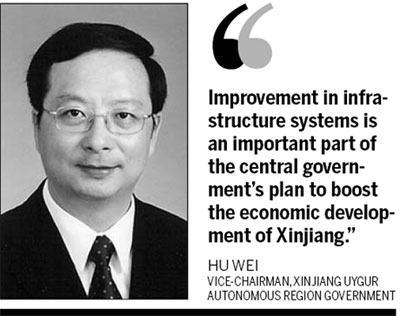
"Improvement in infrastructure systems is an important part of the central government's plan to boost the economic development of Xinjiang," said Hu. "It will further strengthen the ties between Xinjiang and neighboring regions."
According to Hu, Xinjiang will see a solid recovery in overseas trade this year compared with 2009.
Trade is expected to return to 2008 levels or even exceed that next year, he added.
"Our target is to achieve 20 percent year-on-year growth this year and strive for 25 percent growth," he said.
However, some uncertainties still exist, such as the political crisis of Kyrgyzstan, which is now the second-largest trade partner of Xinjiang, he added.
The autonomous region saw 51 percent annual growth in foreign trade in 2007 and a 62 percent increase in 2008. But because of global economic turndown and the July 5 riots in 2009, its foreign trade dropped by 37.8 percent in total value from a year earlier.
Xinjiang's foreign trade was $22.2 billion in 2008, ranking 12th among the mainland's 31 provinces, regions and municipalities, while its exports were $18.7 billion, ranking 11th in the country.
The region's foreign trade rose 13 percent year-on-year in the first half of 2010.
In order to increase trade this year the local government has taken a host of measures, such as strengthening port management, streamlining customs clearance, and increasing imports, said Hu.
The regional government will also encourage some industries and enterprises to accelerate their expansion into overseas markets, such as agricultural products, mechanical and electrical products sectors, he added.
Bordering eight countries, Xinjiang will play an increasingly significant role in China's overall foreign trade.
China's increasing reliance on overseas energy resources will also make Xinjiang ever more important in China's foreign trade, he said. Rich in oil and gas reserves, Central Asian countries are important places for China to import energy from.
Commenting on overseas investment in Xinjiang, Hu said it still accounts for a very small part of the region's economy, although it has seen 20 to 30 percent annual growth in the past few years.
"Investment from eastern provinces now accounts for a major part and we will continue to focus on attracting investment from those regions," he said.
These investments mainly go to sectors including mining industries and agricultural product manufacturing, said Hu.
Overseas investment now mainly goes to agricultural products processing and services sector in Xinjiang, he added.