Society
Contaminated waters that kill
By Wei Tian, Hu Meidong and Zhu Xingxin in Fujian, and He Na in Beijing (China Daily)
Updated: 2010-07-16 09:20
 |
Large Medium Small |
|
|
History of problems
Zijin Mining Group, which is listed on the Hong Kong and Shanghai stock exchanges, has had problems with pollution before, according to Ma Jun, director of the institute of public and environmental affairs, a non-governmental group based in Beijing.
The Ministry of Environmental Protection in May issued a statement criticizing 11 listed enterprises for environmental damage, he said. Zijin Mining Group was one of those on the list.
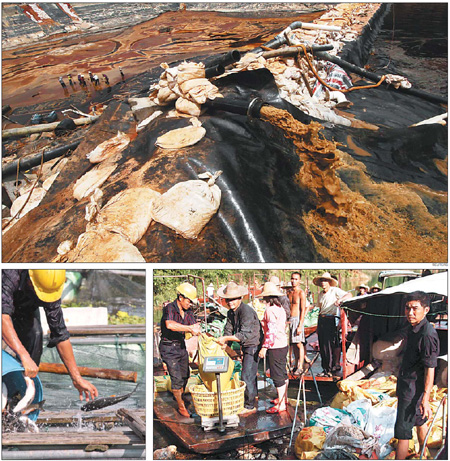
"We don't know much about Zijin Mining," said Huang Zhongxiang as he waited anxiously to weigh in his dead fish in order to get his compensation. "All we care about is the fact the number of fish is decreasing quickly."
Fujian authorities have pledged to pay 12 yuan for every kilogram of fish that is handed over to them, dead or alive, to cover the losses of those who suffered from what they call "an enormous environmental disaster". Officials also want to prevent contaminated fish being sold to markets.
For some business, though, the amount is unlikely to cover all of their losses.
"Some of the more expensive fish, such as the guang fish, fetch 24 yuan per kg on the market," said Huang, whose fishery is in Hetou village. "All we can do now is sell them for 12 yuan. It's better than nothing."
"I owe money to the bank, my fish food provider and some friends," added Qiu, whose fishery is worth an estimated 1 million yuan. "How can I pay off all these debts if I only get 300,000 yuan in compensation?"
Qiu has refused to sign the compensation agreement offered by the provincial authorities.
All of the dead fish collected by the government are quickly packed in plastic bags and transported to remote mountain areas to be buried.
"We have been burying tons of fish here every day for the last three days," said an excavator driver surnamed Wang at one burial site. He explained that he earns a fairly decent 180 yuan per hour, although the stench at the site is almost unbearable.
Huang said he had heard a few villagers have been visiting the burial sites to steal dead fish and then resell them to the authorities the next day.
Fears for the future
Following the severe pollution in Tingjiang River, government officials have banned villagers from running fisheries on the waterway for at least three years.
"Our biggest worry is our future," said Huang. "What are we going to do if we can't be fishermen?"
The villager has worked a fishery since 1998, when his previous home and farmland was submerged as part of construction of the Mianhuatan hydropower station. Now he must find a new career.
Qiu showed China Daily a leaflet distributed by officials that lists the types of jobs the out-of-business farmers can consider, while promoting the training sessions provided.
"Most are technical jobs that pay 3,000 yuan a month at most," he said. "I am almost 40. Even if I have the time and energy to be trained, how am I going to feed my family with this salary?"
He said he could earn 5,000 a month driving a taxi in Xiamen.
"I still hope the government tells us how soon the river will be ready to breed fish again," said Qiu. "If it's within 2 or 3 years, I would choose to stay and start again. After all, I love being a fisherman."
Scientist Wang Shengrui explained that, if the pollution is minor, the water quality of the river should recover naturally within five years.
According to the latest report by the Fujian environmental protection department, PH tests show the water standard to be at Level 3, which is suitable for swimming and fisheries.
Statistics from the Ministry of Environmental Protection show 9,123 enterprises were involved in heavy metal pollution during production in 2009. Almost 2,200 were found to be harmful to the environment, with 231 closed down and 641 ordered to halt all operations.
A draft of the Planning of Comprehensive Heavy Metal Pollution Control regulation has already been drawn up by the Ministry of Environmental Protection and will be put into force after approval by the State Council.
Meanwhile, NGO director Ma urged officials to increase the amount of compensation to help those recovering from the Tingjiang River leak.
"What will these fishermen do in the future? The company needs to pay more and the practice needs to be promoted in other pollution cases in the future," he said.