Society
Buddhist treasure unveiled
(China Daily)
Updated: 2010-06-14 10:33
 |
Large Medium Small |
NANJING - The parietal bone of Sakyamuni, considered one of Buddhism's most sacred relics, was unveiled on Saturday morning by Buddhist monks and archaeologists as millions watched the ceremony live on TV.
The top part of what is believed to be Sakyamuni's skull was taken out from a miniature gold coffin nestled inside a silver one at 9 am during a religious ceremony held at Qixia Temple in Nanjing, capital of Jiangsu province.
The bone, irregular and light brown, looked like a small rock. "It is full of cell-like cavities, just like a honeycomb," said Hua Guorong, deputy head of the Nanjing City Museum.
"Our findings conform with the descriptions of the parietal bone in historical records," said Xue Cheng, vice-president of the Buddhist Association of China.
Besides Sakyamuni's relic, 10 sacred pieces of remains of other Buddhas were also found in another gold and silver mini-coffin.
|
|
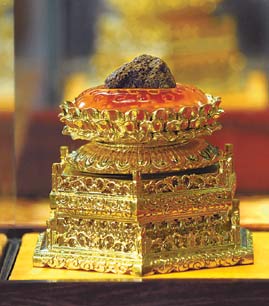
The relics will be open to the public for a month, Hua said.
To ensure the safety of the treasures, Saturday's ceremony was held under heavy security; the indoor temperature was maintained at 20 C, and humidity between 55 and 60 percent.
The parietal bone of Sakyamuni, believed to have been recovered from the cremation ashes, had been stored in a miniature pagoda, named the Pagoda of King Asoka, which was unearthed two years ago in an underground palace built in 1011 at the former Changgan Temple in Nanjing.
The palace was discovered when archaeologists began excavating the ruins of the Grand Bao'en Temple of Nanjing, built in the Ming Dynasty (1368-1644).
In July 2008, archaeologists found a stele in the palace, the inscription on which said the palace preserved a "Seven-Treasure Pagoda of King Asoka" containing gold and silver coffins with Sakyamuni's parietal bone and relics of other Buddhas.
A month later, an iron case containing a pagoda was unearthed from the palace, and in November 2008, archaeologists removed the pagoda from the case and found two mini-coffins.
It is said that 2,500 years ago, Sakyamuni's disciples recovered one parietal bone, four teeth, two collar bones and 84,000 particles of relics from the cremation ash of Sakyamuni, according to Lu Jianfu, a senior official with the Buddhist association.
Asoka, an Indian emperor (273-232 BC), is believed to have collected all the parts of Sakyamuni's remains, stored them in pagoda-like shrines, and sent them to different parts of the world.
The pagoda in Nanjing is believed to be one of the "pagodas of King Asoka" that contain Sakyamuni's remains.
The four-layer, 1.21-m-high and 0.42-m-wide pagoda is the largest of its kind unearthed in China.
According to Tang Dynasty (AD 618-907) Buddhist records, China had 19 pagodas of King Asoka holding Sakyamuni's relics. To date, seven of them have reportedly been found in the country.