Society
Excavation of Cao Cao's tomb throws up new mysteries
(Xinhua)
Updated: 2010-06-12 19:05
 |
Large Medium Small |
|
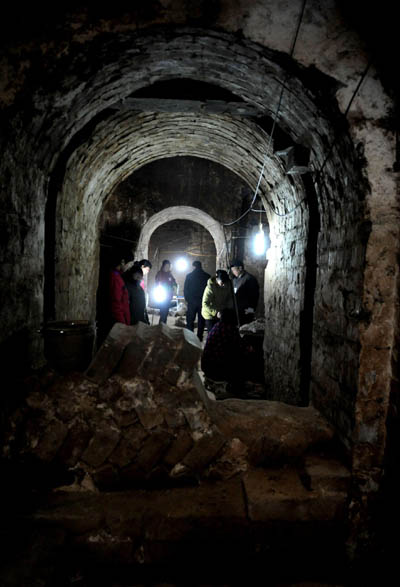 This photo taken on December 30, 2009 shows archaeologists unearthed the tomb of Cao Cao, a warlord during the Three Kingdoms period (208-280 A.D.), in Anyang of central China's Henan province. [Photo/Xinhua] |
Although the excavation of the mausoleum is almost complete, archaeologists are still puzzled by the purpose of the No 1 pit, which was found to contain only an iron sword.
"The tomb was built at the same period as the main tomb, and the two are only 30 meters apart. The No 1 pit is smaller and less decorated, which suggests it is a satellite tomb," said Pan Weibin, a chief researcher with the provincial bureau.
He said the tomb had been severely damaged with seven holes opened by tomb robbers.
There are many assumptions about the tomb. Some said it had been occupied by Cao Ang, eldest son of Cao Cao, who died before his father.
Popular speculation has it the tomb might have stored Cao's weapons, or jewelry, or books.
Liu Qingzhu, member of the Chinese Academy of Social Sciences (CASS), said the function of the satellite tomb was still a mystery, but it must have reflected Cao Cao's thoughts.
He said experts have generally ruled out theories that the tomb had been occupied by Cao Cao's wife or one of his favorite concubines, as the tomb's standard suggested it was of a lower class.
New findings
During CCTV's live broadcast to mark the fifth Chinese Cultural Heritage Day Saturday, a ninth stone stele engraved with characters showing the name of a weapon used by the general from the No 2 tomb was unearthed.
However, the stele's upper part was missing.
"The missing fragment should carry the engraved characters of Weiwuwang or the King of Wei like the eight other steles. However, all of the steles and stone carvings with the king's name have suffered human damage," said Liu, of the CASS.
He said the severity of destruction surprised archaeologists. Besides the damage to items with the king's name, the male skull discovered in the front of the main chamber indicated that the body had been dragged out the coffin and the face smashed.
Experts assumed that Cao Cao's rivals caused some of the destruction as well as tomb robbers.
|
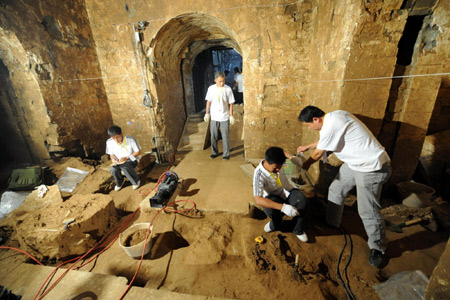 Archaeologists unearth the tomb of Cao Cao, a warlord during the Three Kingdoms period (208-280 A.D.), in Anyang of central China's Henan province on Friday. The day marks the fifth Chinese Cultural Heritage Day. [Photo/Xinhua] |
Other intriguing findings:
Archaeologists are also studying the 6-meter high main chamber's ogive, or pointed arched, roof, similar to that of a church spire, which is rare for tombs of that period.
Many stone and pottery miniatures of living necessities were unearthed from the tomb, such as a hogpen with the function of a toilet, a stone well, ancient musical instruments and writing desks.
Liu said many items suggested the tomb master, though a warlord, was immersed in the arts. This complies with historical records showing Cao Cao was a military strategist, veteran politician and man of letters.