Society
Price hikes in certain basic goods fuel inflation fears
By Shan Juan (China Daily)
Updated: 2010-06-05 08:39
 |
Large Medium Small |
 |
|
A man shops?at a supermarket in Beijing on Friday, June 4, 2010. [China Daily] |
Beijing - Prices of daily necessities including milk powder, tissue paper and tea have risen nationwide in recent months, following previous price hikes in a number of farm products.
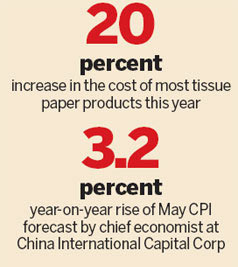
The price of a number of high-end milk powder products increased by up to three times this year, while the price of tea from the spring harvest has risen by 20 percent year-on-year, media reported. Most tissue paper products also rose by 20 percent year-on-year.
| ||||


Ha Jiming, chief economist at China International Capital Corp, forecast that the country's consumer price index (CPI), a major gauge of inflation, will increase by 3.2 percent in May from a year earlier, Xinhua News Agency reported.
CPI annual growth rate could peak at 4 percent in June and July, Ha told an investor conference in Beijing.
The government also reiterated an inflation target of 3 percent for the year.
But a surge in prices of certain products like garlic or mung beans will have a limited impact on overall inflation, authorities said.
Recent price hikes in non-staple products like garlic, vegetables and mung beans were reportedly due to factors like regional drought, speculation and hoarding.
Food prices account for one-third of China's CPI basket, official statistics showed.
The recent price hikes will not affect the CPI significantly because the consumption of the affected non-staple agricultural products is relatively low and their demand is flexible, said Peng Sen, vice-minister of the National Development and Reform Commission, the country's top economic planner.
Zhang Lin, a Beijing-based white-collar worker, thought otherwise.
"Inflation will definitely pick up in China as the price of almost every thing is on the rise," she said.
Speculative funds looking for new investment channels as stock prices fell and tightening measures hit the property markets are partly responsible for expectations of inflation, Peng said.
Mung beans cost 9 yuan (US$1.32) a kilogram in October 2009 but soared to 20 yuan for the same amount by May, figures from the National Bureau of Statistics showed.
Prices for black soybeans and glutinous rice have also increased significantly.
The government has rolled out anti-speculation measures, including monitoring prices, punishing irregular trading activities and increasing supply, to help cool the price hikes.