Society
Rare Chinese sturgeon under threat at Three Gorges
By Jin Zhu (China Daily)
Updated: 2010-06-02 07:41
 |
Large Medium Small |
|
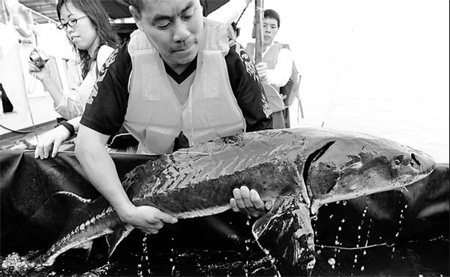 Workers from Xiamen Oceans & Fisheries Bureau of Fujian province release a Chinese sturgeon into the sea on April 22. A total of 108 sturgeon were released into the sea that day near Xiamen. [Zhang Guojun / Xinhua News Agency] |
BEIJING - Storing water at the Three Gorges reservoir has put off the reproductive period of wild Chinese sturgeon for about a month and may further reduce the number of the already rare species, a leading expert has said.
Wild Chinese sturgeon, an animal thought to have lived at the same time as dinosaurs and among the first class of protected animals in China, are now breeding during the last ten days of November.
That is about one month later than its usual reproductive period in late October, said Xiao Hui, chief engineer with the Chinese sturgeon research institute under the China Three Gorges Corporation.
Xiao observes wild Chinese sturgeon that migrate to the Yangtze River to lay eggs every year.
"Their reproductive time has gradually been delayed since the Three Gorges reservoir began to store water in May 2003," she told China Daily on Tuesday.
According to the institute's study, the reproductive period was delayed for a week after the water level in the reservoir reached 135 meters. When the water level rose to 156 meters, it became 15 days later than usual.
Last year, the reproductive period for the rare species was delayed about a month after the water level rose to 75 meters in September.
The current spawning site of wild Chinese sturgeon remains in the lower reaches of the Yangtze River. The site is 7 km away from another large hydroelectric plant, where the Gezhou Dam stopped the sturgeon from swimming to the upper reaches of the river since it was completed in 1981.
"After the Three Gorges reservoir began to store water, the water level of the lower reaches of the river has remained low. It also needs more time to reach a proper water temperature (usually between 17 and 21 C) for the sturgeon to lay eggs," Xiao said.
Every September to November, Chinese sturgeon swim against the sea to lay eggs in the Yangtze River. "Since the young fish have insufficient time to grow into adult fish, their survival rate could be cut when they swim back into the sea," she said.
At present, about 300 wild Chinese sturgeon migrate to the Yangtze River every year to lay eggs, experts said.
Although there is no evidence so far to show whether the delay in their reproductive period will lead to a decrease in the number of wild Chinese sturgeon, authorities have already started taking measures to protect them.
"The Ministry of Agriculture once allowed us to catch 10 wild Chinese sturgeon every year for study, but it has been banned since last year," Xiao said.