Web Exclusive
Picking up pieces of old memeries at coupon exhibition
By Cheng Anqi (chinadaily.com.cn)
Updated: 2010-05-12 13:27
 |
Large Medium Small |
People who tour Beijing Aquarium are surprised by a special exhibition set in its main gallery displaying a variety of commodity grain coupons about the size of a name card.
The exhibition, collected by the aquarium's senior member Zhang Wei, a 48-year-old ration coupons enthusiast, is made up of 10 billboards with over 500 culture pieces issued by the whole 32 provinces and cities, ranging from general coupons, local coupons and military ration coupons.
The ration system got started in China in 1955 when commodities were scarce during the early days, and loosened its control in 1990s, following the growth of industrial and agricultural production.
|
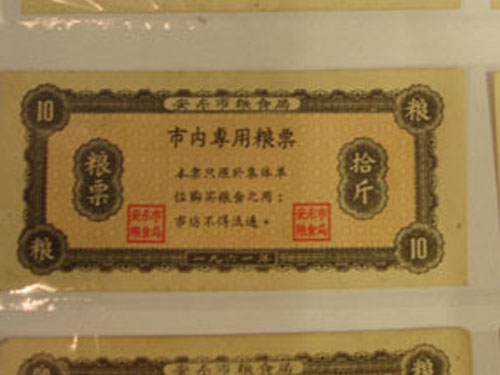 The most precious coupons series in his collection was launched in Andong city in Northeast China's Liaoning province in 1961. [chinadaily.com.cn]
|
"I'm so grateful for the chance given by the aquarium to allow me to share my treasures with more visitors, because liangpiao (grain coupon) is the most striking in people's memory," says Zhang, who began collecting ration coupons in 1986 and has housed nearly 5,000 items with 10,000 culture pieces.
Among his collection, the most precious coupons series was launched in Andong city in Northeast China's Liaoning province in 1961. The city, known as Andong until 1965, replaced its name by Dandong, which endued the coupons with more meaning.
Food grain ration coupons were first introduced in the mid-1950s after the central government decided to stabilize the grain market and balance demand and supply. China adopted a system of planned purchase and supply to monopolize the selling and buying of grain from 1953.
The coupons were issued for foodstuffs, fuel, even bicycles and televisions. Without them you were not permitted to purchase the goods.
Before China's economy reforms and opening up in the late 1970s, however, "People were living a simple life. At the time, you might have money, but you couldn't get what you needed or wanted," Zhang recollects.
Back then, he recalled that during that time frame, he would get up in the wee hours and stand in line for a thin slice of pork. "Even if you had tons of money, you still ate a mostly vegetarian diet because most food items, except vegetables, required coupons," Zhang recollected. "In the countryside, meat was available only on rare occasions, such as the Chinese New Year, when households would slaughter a pig they had raised and feast for a week."
The average ration was 15 kilograms for a man and 13 kilograms for a woman each month, though it varied somewhat with age, profession and location. Meat was much scarcer and it was rationed at Ban Jin (0.25 kilogram) per person per month. These coupons were given per person, no matter how poor or rich that person was, therefore the ration coupons are much scarcer than Chinese Yuan banknotes.
Zhang also exchanges his collection items for other ones on the Internet. The items to be exchanged on the forum can really dazzle one's eyes.
Currently, a common coupon normally costs three yuan. Price for one or two kilograms coupons is averagely 500 yuan ($73) but it soars high up to 1,500 yuan ($210) for the version issued in 1955.
|
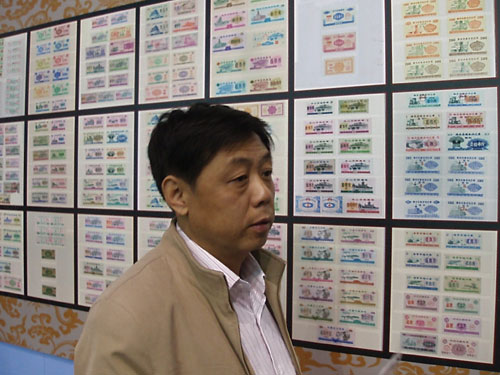 The exhibition, collected by the aquarium's senior member Zhang Wei, a 48-year-old ration coupons enthusiast, is made up of 10 billboards with over 500 culture pieces issued around the country, ranging from general coupons, local coupons and military ration coupons. [chinadaily.com.cn]
|