Society
Most quake survivors still traumatized
By WANG YAN (China Daily)
Updated: 2010-05-07 07:04
 |
Large Medium Small |
BEIJING - Nine in every 10 Wenchuan earthquake survivors suffering from psychological disorders have not received treatment, an expert said.
Most patients do not even realize they are suffering from post-traumatic stress disorder (PTSD), while others are too shy to seek help from a consultant, Zhang Wei, deputy director of the West China Hospital, told China Daily on Thursday.
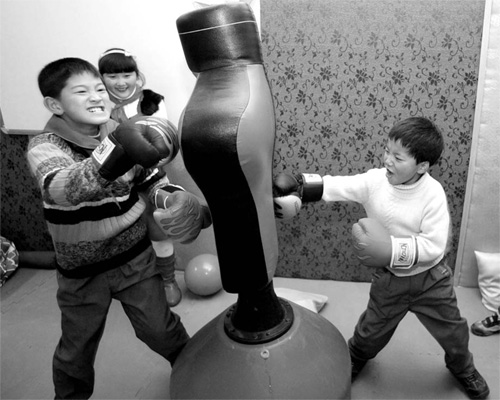 Children from Deyang of Sichuan province, which was hit hard by an earthquake two years ago, play at a psychological consultation center in this file photo. |
Zhang has led a team for post-quake psychological reconstruction since the devastating earthquake hit Wenchuan, Sichuan province, in 2008.
"The quake affected about 30 million people. With a prevalence rate of PTSD of up to 4 percent, there are more than 1 million patients out there. It's a large number," Zhang said.
"A typical symptom of PTSD is to often recall the disaster. For example, a woman who witnessed the death of her husband in the quake has continued to replay the scene in her mind, which is now seriously affecting her life and work," he said.


Even those who are aware of PTSD may be reluctant to seek psychological help, because mental health problems are usually stigmatized in traditional Chinese culture.
"I hope patients know the disorder has nothing to do with moral issues," Zhang said.
He said that while the prevalence rate for PTSD of 4 percent applied to general survivors of the Wenchuan quake, the rates are even higher for specific groups who endured the disaster, including students and officials.
"Students are vulnerable to the disorder because many of them witnessed the death of their peers," he said, adding that officials, including the police, are also vulnerable because they not only experienced the quake, but were also subjected to high pressure in their dual roles of saving lives and aiding reconstruction.
In addition to PTSD, anxiety, hypersensitivity, sleeping disorders and depression are also seen among earthquake survivors, he said.
While Zhang's team has been making every effort to provide psychological counseling to the survivors, more grassroots support is needed.
"We hope that officials at all levels of government understand the importance of psychological consultation," he said.
Zhang and his team, who expect the project to last for at least 10 years, are currently seeking to train local doctors to assist with the project, because many patients feel more comfortable with doctors they already know and trust.
"Post-quake psychological reconstruction is never a short-term job," he said. "Without mental intervention, negative symptoms could last up to 20 years. Our goal is to help patients erase the shadows as soon as possible."