Society
Migrants put behind fences
By He Na (China Daily)
Updated: 2010-05-06 07:35
 |
Large Medium Small |
However, when China Daily visited the area this week, many residents were skeptical that the high fences and guards will help reduce crime.
"Most crime here happens in the early hours of the morning," said the owner of a cell phone shop in the village who did not want to be identified. "If they really want to improve the public security, I suggest they close the village after midnight and enhance patrols at that time."
His business has been badly affected by the closure, he said. Before, he could sell more than 10 phone cards and two or three cell phones a day. Now he barely sells anything.
"Most of my customers are young people from nearby factories, so the closure of the village has left us dead in the water," he complained.
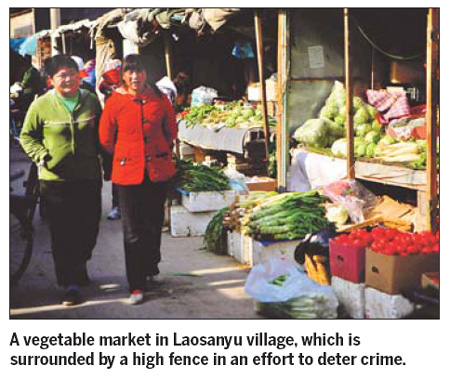
Jiang Zhengqing, who owns a supermarket close to the village entrance, said the number of customers at his shop has also reduced drastically. "Before, the streets were crowded with people in the afternoon but now the village is deserted," he said. "If the situation continues like this, it will become hard to make ends meet. I don't know whether I'll still be in business next year. I can't understand why the (district) government has invested such a large amount of money into putting up these useless fences, rather than repair our dirty public restrooms and bumpy roads," he said.
Ye Xin, a 23-year-old migrant worker from Heze, Shandong province, has worked as a cashier at the supermarket for a month. She added: "I hope the fences will be removed soon. If the number of customers keeps reducing, I could lose my job."
Thanks to its cheap rent and convenient transport links into the capital, Laosanyu not only attracts migrant workers, but also many petitioners (people who come to the capital to protest corruption or injustice in their province), according to a recent report by Beijing Times.
"I know there are still many (petitioners) living in the village. If they (officials) carry on with the close inspections every day, I am sure many will leave," a petitioner surnamed Wang from Heilongjiang province was quoted as saying.
Behind the barriers
Despite strong opposition from some of the floating population and several experts, several residents insisted the furor will die down quickly.
"The security guards just pretend to work seriously for their superiors. The security will gradually loosen again as time goes by," said a grocery store owner surnamed Li from Xinyang, Henan province, who has lived in Laosanyu for four years. "More than 7,000 people live in the village now. Who does not have friends or relatives? Can they stop all these people from visiting?"
Chen Debao, another official with the Daxing public security bureau, said the new measures are not designed to keep people out of the village.
"As long as people can provide their identifications and the purposes of entering the village, they are all allowed to enter. It won't affect people's daily lives," he said.
However, analysts say the controversy surrounding the feng bi system reflects the need for clear legislation to manage the floating population.
"The regulations on migrant management today are not only complicated but also contradict each other," said Tang Jun, secretary-general of the Chinese Academy of Social Sciences' center for social policy studies. "We are in dire need of a national unified law.
"We also need to enhance the protection of the rights of migrant people, to clear up their rights and responsibilities in the terms of law."
The most effective way to manage the floating population is actually by getting migrants involved in the process, said Tang. "Migrant people need to have a sense of security. If we could increase the number of their representatives in local residential committees to gather their opinions and suggestions, the effect would be far better."
Compared to other districts, Daxing's population structure makes it a difficult place to manage, said research director Yuan Chongfa, who argued that the situation also highlights the need to overhaul China's much maligned hukou system.
"Cities are still managed through hukou but it is not a good way to deal with the large flow of migrant population," he said, urging the central government to look abroad for inspiration on how to solve the problem.