Society
The Year of dead Tigers
By Hu Yongqi and Wu Yong in Shenyang, and Cao Li and Wang Zhuoqiong in Beijing (China Daily)
Updated: 2010-03-19 06:37
 |
Large Medium Small |
Supervision of China's zoos comes under too many different departments to be effective, with responsibility shared among construction, forestry and tourism officials, said Liu Nonglin, program director with Chinese Association of Zoological Gardens.
"Because of lack of effective supervision, we are seeing many problems, particularly with private zoos and farms," he said. "We see late payment of workers' wages, growing debts, low feeding standards and inadequate management techniques."
Forestry officials at local levels are charged with overseeing zoos but they are not in charge of their finances or resources, said Liu Xiongying, a senior information official with the State Forestry Administration.
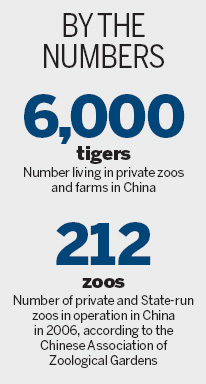
There are more than 1,000 tigers at farms in Harbin, capital of Heilongjiang province, and in Guilin, according to Liu Nonglin. As most of them were established in the hope of commercializing tiger products, the ban on such trade has left many businesses with too many tigers to feed and not enough money with which to do it. Some of them have even resorted to trading tiger parts, mostly tiger bone wine, on the black market, said Liu Nonglin.
The variety in zoo ownership and lack of legislation against animal abuse are letting zoo owners run wild, said Hua with International Fund for Animal Welfare. "Zoos do not have standards to stick to, or guidance on the management and medical requirements of rare animals. It makes it difficult to hold anyone responsible when they are working with a loophole in the law," he said.
Considering the number of tigers kept at Shenyang Forest Wild Animals Zoo, it is difficult to say whether Yang, the owner, has collected so many animals to exhibit them for the purposes of education or to commercialize them, said Xu Hongfa, China program for TRAFFIC, a joint conservation program by the World Wildlife Fund for Nature and the World Conservation Union.
"Normally, zoos control the amount of animals, especially rare animals, according to their capability to look after them because they cost a lot to feed. But this private zoo has more tigers than most public zoos," he said.
Xu Jianzhong, manager of animal feeding and management at Shanghai Wild Animal Park, the second largest in China "We decide the number of rare animals according to our capability. Most zoos have no more than 5 tigers," he said. "We opened the park after a strict examination procedure and we are subject to constant checks by the local forestry bureau and Shanghai Wild Animal Protection Center."
Although the trade of tiger parts products has been illegal in China since 1993, tiger farms and some zoos have appealed for the government to overturn the ban.
Animal rights experts warn such a move would threaten those tigers still living in the wild.
Zhang Xiaomin in Dalian and Liu Ce in Shenyang contributed