Society
Garbage in, pollution out
By Li Jing (China Daily)
Updated: 2010-03-18 06:42
 |
Large Medium Small |
Plastics is not just a business in Wen'an county, it is a way of life. Villagers can be seen using plastic bottles to fuel fires for cooking, or to heat their homes. However, the health impacts of this practice have become a real concern, said residents across Wen'an county, many of whom claimed that the plastics industry is directly linked to an increase in the number of people with enlarged livers.
"In recent years, none of our young people have been recruited into the army. They all failed the physical examination as their livers were abnormally large," said Wang Rongde, 60, a villager in Lugezhuang.
 |
|
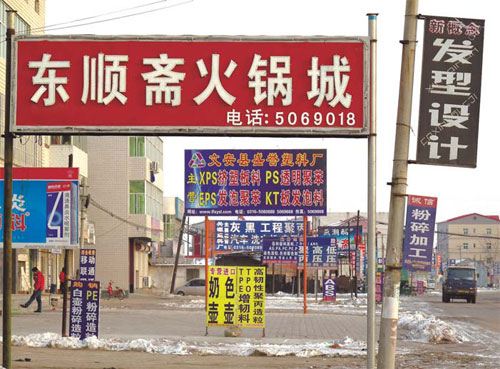
Large advertising boards describe the kinds of plastics diff erent recycling companies handle in Wen’an county, Hebei province. The county has become dominated by family-run plastics recycling fi rms over the last 30 years. [LI JING/ CHINA DAILY] |
Although there is no evidence of a link, locals believe the condition is a result of unchecked air and water pollution. "Villagers know the implications for the environment and health, that's why all of our drinking water is pumped from 500 meters underground," said Wang.
Some villagers even refuse to drink water from underground sources for fear of it being contaminated. Many buy bottled drinking water, he said. "Water for industrial use is from wells that are around 40 meters deep. Nobody would dare drink that."
Like in most villages, the wastewater used to clean plastics at family-run factories in Yincun is directly discharged into the sewers, which takes it north to a large treatment plant built in 2007.
The sewage works cost more than 1.4 million yuan to construct and can handle up to 1 ton of wastewater every day. However, when a China Daily reporter visited the area recently, the plant was closed. A security guard at the gate said the plant was halted due to bad weather - the site was covered with thick snow - but villagers said it had never been put into full operation.
The situation in Wen'an county is by no means rare in China, the world's largest consumer of plastics, said Ma Zhanfeng, general secretary of China Plastics Processing Industry Association.
China's plastic consumption reached 52 million tons in 2008, according to the association, which in a country with a population of 1.3 billion equates to about 40 kg per person. In both North America and Western Europe, consumption is about 100 kg per person and analysts say that it could hit 140 kg by 2015.
"Some big cities, such as Beijing and Guangzhou (capital of Guangdong province), are already facing a garbage crisis as they're running out of space for landfills. It means that mechanical recycling - melting and granulating - is still the best way to deal with waste plastic," said Ma.
Although there are large-scale recycling enterprises located along China's coastline, they process only imported industrial waste, which is clean and easy to sort, say analysts. Only small, family-run factories are recycling domestic household waste plastic.
"People think waste plastic is worthless but once they are separated into different groups they have a very high value," said Ma.
There are more than 20,000 small enterprises involved in plastic recycling, with most clustered on the outskirts of large cities, he said. "Among these small businesses there is a clear division: some specialize in sorting, others focus on melting and granulating. They're very active. Our statistics show the output of this industry has increased from about 2 billion yuan in 2000 to 100 billion yuan in 2007."
And as the vast majority of these family-run factories do not have the necessary pollution treatment facilities, they usually run at a lower cost than medium or large enterprises, making them more "competitive".
A company called Jiacheng set up a PET recycling plant on the Dongdu Industrial Park, a 1.4-billion-yuan project just 30 km from Yincun, shortly after the industrial zone opened in 2008. The plant even had its own sewage treatment facility to ensure the process was green. However, due to high costs, the plant never opened.
"The prosperity of small-scale recycling enterprises is the result of market selection," said Ma. "Simply banning the business is not the solution for pollution problems. Family-run factories need guidance from the government to upgrade their business.
"Currently there are no specific policies for plastics recycling despite the promotion of a green economy."