Society
Drought biggest threat to agriculture
By Jin Zhu (China Daily)
Updated: 2010-03-16 07:01
 |
Large Medium Small |
|
|
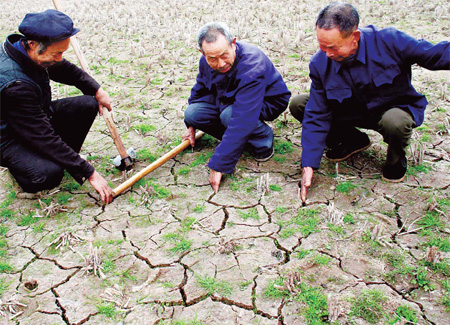
BEIJING: Extreme weather caused by climate change is posing a grave threat to China's food supply and its targeted growth, experts warn.
China plans to increase its grain output by 50 million tons to 550 million tons by 2020. However, the impact of climate change, including rising temperatures, loss of arable land, shortage of water and extreme weather will make the target more difficult to achieve, agricultural experts said at the International Workshop on Sustainable Food and Agriculture on Monday.


According to statistics from the local agriculture bureau, rainfall has decreased from 400 millimeters in the 1970s to less than 100 millimeters in the last five years.
"Wheat and corn are the main local crops. However, most farmers are not willing to plant wheat as scarce water resources and increasing salt in the soil have caused great losses in wheat output," Wen told China Daily.
"The current soil conditions are still suitable for corn in the next 10 years. Then farmers can plant radishes, which are more salt-tolerant," she said.
"However, when radishes can't be planted anymore after 10 years, what should they plant?" Wen asked.
According to statistics from the Chinese Academy of Agricultural Sciences (CAAS), the average annual crop losses due to drought in China were 75.7 billion yuan ($11.1 billion) from 1988 to 2004, while annual losses due to flood were 51.1 billion yuan.
"Drought has become the greatest disaster facing China's agriculture," said Lin Erda, a professor with CAAS.
As climate change continues, China is likely to face an inadequate food supply by 2030 and the country's overall food production could fall by 23 percent by 2050, a previous report released by Greenpeace predicted.
Now is the time to improve the ability of farmers and rural regions to adapt to climate change, and developing sustainable agriculture is a way out, Lin said.
Lin's research focuses on the impact caused by climate change in areas such as Heilongjiang province and the Tailanhe River basin in the Xinjiang Uygur autonomous region.
"We hope to estimate the potential damage to local agriculture and then take measures to protect it," he said.
If proven successful, the measures can be used across the country, Lin added.