Economy
Cell phone puzzle: Imitation, innovation, irritation
By Peng Yining (China Daily)
Updated: 2010-02-23 06:57
 |
Large Medium Small |
Nation's drive to establish new international standard has led to cell phone users' interests being sacrificed, telecoms experts tell Peng Yining
When it comes to technology, national leaders insist China's sights are fixed firmly on innovation, not imitation. But experts warn that the desire to set global trends rather than follow them has led to consumers' interests being sacrificed for "techno-nationalism".
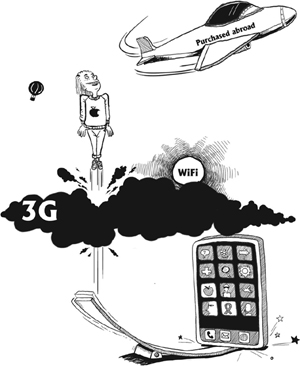
The claims come amid anger over a government block on the iPhone's Wi-Fi function that analysts claim has frustrated buyers and caused a boom in the gray market for the Apple bestseller.
The decision to disable Wi-Fi - wireless Internet access - on iPhones sold on the mainland was to allow China more time to establish its homegrown standard, WAPI, which plugs gaps in security and protects users, said State telecommunications officials.
"Homegrown standards are necessary for an industry's development. We can't use other countries' standards forever and always let others be proactive," said Qin Zhiqiang, vice-director of the Technical Committee on Wireless Network and Secure Network Access, which runs WAPI.
WAPI was introduced in 2003 but faced resistance from manufacturers abroad. It was the country's first entry into the global standard market and Western nations held strong preconceptions about China's technology, said Qin.
WAPI was finally recognized by the International Organization for Standardization (ISO) last June.
"China didn't recognize Wi-Fi because of its safety loopholes and lack of regulation, not because we had our own homegrown standard," said Qin, who revealed 120 companies have already signed up to work with the committee since 2006.
Kan Kaili, a telecoms expert based in Beijing, disagreed. "China disabled Wi-Fi because of WAPI. In order to promote this so-called national innovation, China disabled Wi-Fi and sacrificed the interests of millions of cell phone users," he told China Daily. "Users can't freely and conveniently access the mobile Web. If they want to, they must take the risk buying a smuggled phone on the gray market."
Although establishing industry standards is important, officials failed to put the consumer first when pushing their WAPI standard, said the professor with the Beijing University of Post and Telecommunications' economics and management school.
"Some standards bring profits, others standardize development. To make the roads safe, all vehicles drive on the left or right side - that's standard, not patent. Wi-Fi is a standard without much economic profit," said Kan. "Some international standards are promoted by government, some grow to meet market demand. Both should put consumers first.
"By persisting with WAPI, Chinese cell phone users have had no legitimate access to Wi-Fi for years. WAPI is no great advancement compared to Wi-Fi."
There are more than 700 million mobile phone users in China and about 181 million regularly use wireless mobile Web services, according to a report by China Internet Network Information Center last October. The Wi-Fi Alliance, a global non-profit organization promoting the adoption of Wi-Fi, also said that 34 percent of all Wi-Fi users access services through cell phones.
"WAPI is safer than Wi-Fi because it prevents data loss and invasions of the network. These safety problems must be solved, but most users don't even realize there are problems," said Xiao Long, chief engineer for IWNCOMM, the major technical supplier and active partner of WAPI.