Government and Policy
Press conference on central govt's contacts with Dalai Lama (Text)
(Tibet.cn)
Updated: 2010-02-11 11:26
 |
Large Medium Small |
Reporter from Voice of America: I have two questions. In your answer, you said China fully rejected the "Memorandum" that Lodi Gyari refered to. I want to ask in what aspects that the Chinese Central Government can make a concession, otherwise how would the Dalai Lama have further talks with you? The second one is in your description, there's nothing but criticism, can I ask why you still want to have talks with them?
Zhu Weiqun: The 14th Dalai Lama has never hidden his political proposition. The so-called "Greater Tibet" and "high degree of autonomy" are all known by the public. These issues are all related to China's territory and sovereignty. There's no room for negotiation and we will make no concession in this regard. But why we still hold talks with them? Because we want to give the 14th Dalai Lama a chance to correct his mistakes. Although the 14th Dalai Lama has long been engaging in activities geared to split the motherland, he said he would not seek "Tibetan independence" at the end of the late 1970s when China launched the reform and opening-up program. Given this, the Central Government began contact and talks with his people who were also arranged to visit the hinterland and Tibet as well. Although the Dalai clique plotted riots in Lhasa in the late 1980s, which resulted in enormous loss in terms of life and property for the Tibetans, the 14th Dalai Lama later expressed willingness to solve problems under the framework of the Chinese Constitution and within of the PRC. So, we started to resume contact and talks with them again.
Zhu Weiqun: Havn't we shown enough sincerity? Isn't it flexible we have made? Isn't it enough careness we have given to the Dalai Lama? Does it mean we have made good concession only when we let him come back to Tibet and resume feudal serfdom system and carry out "the Greater Tibet" or "high degree of autonomy"? We have carefully explained and talked to them on the "Memorandum for All Tibetans to Enjoy Genuine Autonomy" and then the "Explanation to the Memorandum". In the talks in November 2008, I told Lodi Gyari, "We will not discuss with you the ‘Tibet Issue', but we may examine your 'Memorandum‘ so that we can find out whether you will give up 'Tibet independence‘ and go back to the patriotic position". And we did fully analyze this "Memorandum" in seven aspects and warned them against the fact that the "Memorandum" is completely against the Central Government and the PRC Constitution. When we said so we were showing them our sincerity and patience, as we could simply ignore the "Memorandum" at all. This time, however, Lodi Gyari again refered to the "Memorandum" to the Central Government, so we could do nothing but criticize them again. If the 14th Dalai Lama doesn't want to be criticized, simply give up all that "Tibet independence", "half Independence" or "convert independence". Until then, the Central Government is satisfied and we will praise him, that's for sure.
Reporter from China News Agency: In the press release sent out yesterday about Vice-Chairman Du Qinglin's interview with the private representatives of the 14th Dalai Lama, we talked about the development and strategic target of the Tibet Autonomous Region since the Fourth National Conference on Work in Tibet held recently. I would like to ask Nyima Tsering, Vice-Chairman of the People's Congress of Tibet Autonomous Region, to say something about his assessment of Tibet's development and his ideas about the future.
|
|
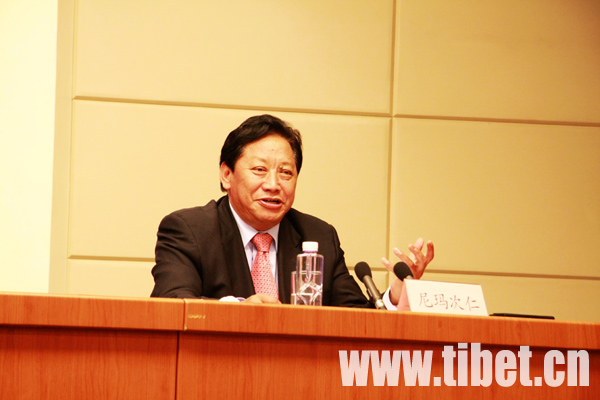
Nyima Tsering: Thanks to the unremitting efforts made over the past 50 years since the Democratic Reform in 1959-1960, especially over the past 30-odd years since the reform and opening-up, people in the Tibet Autonomous Region now lead a well-off life and the development of Tibet stands at a new height. Tibet's GDP saw a 12.1% increase last year, with the average annual income of farmers and herdsmen rising up by 13%. The farming and pastoral areas in Tibet were also changed for the better: some 230,000 households composed of 1.23 million members moved into new houses; the construction of infrastructure has witnessed tremendous improvement; the protection and development of ecological environment has been strengthened in an all-round way; the public causes, including education, science and technology, culture and public health have all developed quickly. The Tibet Autonomous Region now enjoys social peace and stability and people lead a good and prosperous life. Students go to school, workers do their jobs, Buddhist believers pay pilgrimage, --everything is normal. The Tibetan people yearn for further development and ever-lasting peace and stability. and cherish the hard-won happy life. It has been the common view of all the people in the Tibet Autonomous Region that unity and stability are fortune, split-up and riots are misfortune. We are glad to see that Tibet received more tourists from home and abroad last year, the number received reaching 5.56 million. Tibet earned 5.24 billion yuan from this, which is a record high.