Hot on the Web
91% think new rich use govt connections
By Xie Yu (China Daily)
Updated: 2010-02-09 07:11
 |
Large Medium Small |
More than 90 percent of people think the neo-rich in China have benefited from networking with government officials and 42 percent have a "bad impression" of the group, a recent survey has found.
In the poll, conducted by the People's Daily, "newly rich families" mainly refer to private entrepreneurs, especially owners of newly emerging family firms on the rich list provided by Forbes or Hurun which have attracted great public attention with their surprising speed of accumulating fortunes. 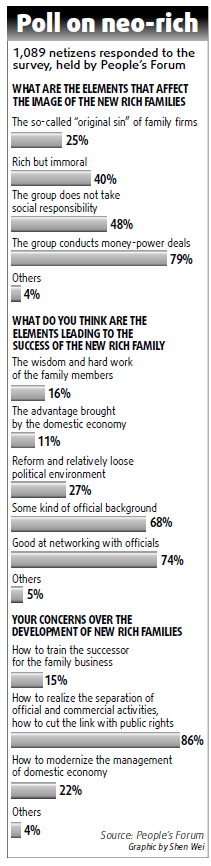
According to the survey, 91 percent of the respondents think all rich families have deep political backgrounds. And 74 percent believe the key to success for these people is "being good at networking with officials" while only 16 percent think "wisdom and hard work of family members" are the reason for their success.
The poll suggested that 69 percent of people think "badly" or "really badly" of the newly rich families in China, while only 3 percent said their impressions of the group are "OK" or "very good".
"The public gives positive evaluation to the ability of the group in making fortunes, and has no bad impression of their firms or assets. What causes resentment are the paths they take to gain wealth and some bad behavior after getting rich," the People's Forum magazine said in a report.
Survey results show most people think the biggest reason causing the public's bad impression of the newly rich families is that they are involved in power-money deals (79 percent), followed by 48 percent who think this group has failed to shoulder its social responsibility, and 40 percent who think the group is rich but immoral.
Meanwhile, 86 percent are concerned about the close relationship between entrepreneurs and officials in China, doubting whether this rich group could have accumulated its wealth if there were no links with officials.
"The tragedy of Huang Guangyu, who was once China's richest person, is caused by collusion with officials," a netizen named Wangxiao001 said on People's Daily website. "It is proving that if there is no strict division between government rights and commercial activities, more tycoons could fall."
Huang, once China's richest man and founder of China's biggest home appliance retail chain Gome, was detained in late 2008 and faces charges of bribery and insider trading. Chinese media said Huang's case has implicated nearly a thousand government officials, from ministry level to grassroots.
Money Week, a weekly magazine under Nanfang Daily, released a list of the top 3,000 wealthiest families in China last year. The list shows the total assets of these 3,000 families reached 1.69 trillion yuan ($249 billion), and the top 10,000 rich families have average property worth 200 million yuan in China.
However, Cai Jiming, director of the Center for Political Economy at Tsinghua University, reminded people to look at the whole picture.
"It is natural to understand the public's anger but we should also be aware that the wealth and deals of bosses in State-owned enterprises are more lacking in transparency," he said.
Cai said an investigation by the Boston Consulting Group in 2007 suggested that 70 percent of China's fortunes were held by 0.4 percent of the population, and this class included not only rich families on various fortune lists, but also many unknown rich people, like bosses of State-owned enterprises, who are getting rich by using the country's monopoly in some industries or abusing public rights.
"So I think problems in this field are more dangerous, and need tighter supervision. While for the private entrepreneurs, I believe they need more guidance, but generally speaking, the booming of the private economy is doing much more good than harm to the nation," Cai said.
(China Daily 02/09/2010 page2)