Society
Laborers vulnerable to rogue job agencies
By He Na (China Daily)
Updated: 2010-02-02 07:48
 |
Large Medium Small |
"My two daughters both study and I was hoping to spend the money I earned in Romania on their education. I didn't think I'd come back poorer than when I went," he said.
 |
|
Zhu Yunxiang, 78, the grandfather of Zhu Yu, one of the workers allegedly cheated by the job agency. [Photo/Feng Yongbin] |
Gucheng Shunda Labor Information Consultation Co Ltd has publicly denied the charges made by the workers. A spokesman declined to comment further when contacted by China Daily.
The Chinese workers arrived in Bucharest in April 2008 and at first things went smoothly, although they often worked overtime, said Li. But in July they received notice from the Romanian Immigration Bureau that their visas had expired and were told to leave the country within 15 days.
"Until then we never realized our visas were not the right type. They were temporary permits valid for only 90 days," said Fang Zhenggang, who was part of the group. They continued to work on the construction project as illegal immigrants, running the risk of being arrested and deported, he said. "We couldn't just go back or that would mean the 80,000 yuan had been wasted."
Disaster also struck when in January 2009 the Chinese workers were evicted from their free accommodation. They were forced to find shelter in transport containers and cowsheds, all the time dodging the Romanian police, and ate soiled vegetables thrown out by locals. They celebrated last Spring Festival at the Chinese Embassy. "We had dumplings that night. It was the best food we had eaten in months," said Fang.
In late February, Gucheng county officials arrived to fly them home to China.
"The intermediate agency does not have a certificate to give out work visas," said attorney Ping. "They not only used temporary visas to cheat the workers and made false promises about the salaries they would get, but also overcharged on intermediary fees."
With a population of 480,000, Gucheng county is one of the biggest sources of transnational migrant workers and has exported more than 10,000 laborers since 2004 to work in more than 10 countries, including Japan, South Korea, Israel, Singapore and Saudi Arabia, according to the county's foreign economic and trade bureau.
"Thousands have returned back after several years' working overseas," said Sun Guangping, head of the bureau. "They not only got some money and work skills but also broadened their outlook. Many of them opened their own business and created 20,000 more jobs."
He said that in Xiaome, a small county village, only two people were working abroad in 2002. That number is now 336, about 20 percent of the population. Each household has about 200,000 yuan in savings, he said.
But although potentially profitable, working overseas presents many pitfalls, warned experts who cited examples of late payment, unsanitary living conditions and racial discrimination, as well as other tragedies.
Vietnamese authorities found 182 illegal Chinese laborers working at a cement factory without visas in June last year. Each was fined 5 million dong ($270) and deported. In 2008, two Chinese workers were kidnapped in Pakistan, while hundreds of Chinese at a textile factory in Mauritius staged a mass protest after one laborer died of exhaustion.
Legal professionals have called for domestic and foreign labor unions to protect the transnational labor
force. "Many employers turn a deaf ear to local laws and regulations. Someone has to be responsible for ensuring Chinese do not suffer discrimination or have their rights abused," said lawyer Ping.
Feng Tongqing, vice-president of the China Institute of Industrial Relations, agreed and said: "With the help of labor unions both home and abroad the situation of Chinese labors overseas would be greatly improved. Laborers are not just commodities; they are real people with legitimate rights and feelings. They need respect, attention and care from motherland."
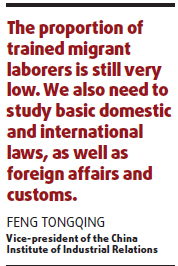
People planning to work overseas should receive more training before going abroad, he said. "The proportion of trained migrant laborers is still very low. We also need to study basic domestic and international laws, as well as foreign affairs and customs."
Experts also urged the government to get even tougher with fraudulent intermediate agencies to clampdown on the number of migrant workers being conned.
"The management and supervision of labor export is very limited and unsustainable," said Chang Kai, director of the institute of labor relations at Renmin University of China. "The government needs to speed legislation and highlight the protection of labor rights and security, as well as take more responsibility in protecting laborers in foreign countries."
He suggested labor counselors be dispatched to all Chinese embassies in countries with large numbers of migrant workers.
Laborers should protect themselves by studying the laws and regulations of the country they plan to work in, and learn key phrases in the host language to prevent disputes, said experts.
(China Daily 02/02/2010 page7)