Society
Experiment launched to prove authenticity of Cao Cao's tomb
By Li Xinzhu (China Daily)
Updated: 2010-01-23 09:57
 |
Large Medium Small |
SHANGHAI: Archeologists and experts from the Shanghai-based Fudan University are conducting a DNA experiment to confirm that a recently excavated tomb in Henan province is Three Kingdoms period (AD 220-280) warlord Cao Cao's mausoleum.
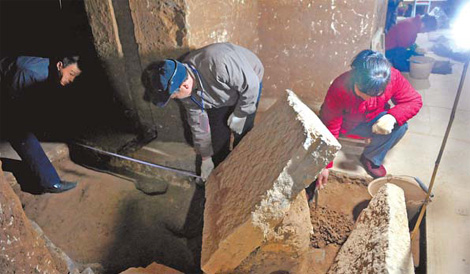 Archeologists excavate Cao Cao's mausoleum on Dec 30, 2009. [China Daily] |
Fudan University has requested people across the country with Cao and Xiahou as their family names to take a DNA test, so that they could match the samples with those recovered from the tomb, which was found buried under a remote village in Anyang county of Henan province late last month.
A number of historians and people from the general public have questioned the authenticity of the tomb, which archeologists are certain is Cao Cao's final resting place.
"We are currently collecting DNA samples. We want as many as possible," said Li Hui, director of the Cao Cao's tomb project with Fudan University.
"We hope to have DNA samples of at least 50-60 people to support our findings," said Li.
| ||||


According to historic documents, Cao Cao can be traced back to the family of Xiahou, with his offspring using the name Cao.
Scientists believe by comparing the Y chromosome of the two families, they will be able to confirm if the families were blood relatives.
In addition, Xiahou is a rare family name in China. That's why scientists decided to invite them from all parts of the country to participate in the research. But only those people with Cao as their family name, who belong to Shandong, Henan and Anhui provinces, have been asked to undergo DNA tests, as those are the birthplaces of Cao Cao's offsprings.
"I think this experiment will work," said Li Ming, a doctor who specializes in the research of single-gene inherited skin disease. "Y chromosome of the human DNA is unique. If they belonged to one family, the DNA will confirm it."
Zhang Jun, a researcher from the Institute of Archaeology, Chinese Academy of Social Sciences, doubted the practicality of the experiment.
"The tomb may have been raided many times in the past. There is no way to determine all the bones recovered from the tomb belong to the same period," she said.
Professor Li Hui told China Daily that proving the link between the Cao and Xiaohou families was essential to prove the tomb belongs to Cao Cao.