CHINA> US T-bonds

|
CHINA> US T-bonds
|
|
China increases US Treasury holdings
By Si Tingting (China Daily)
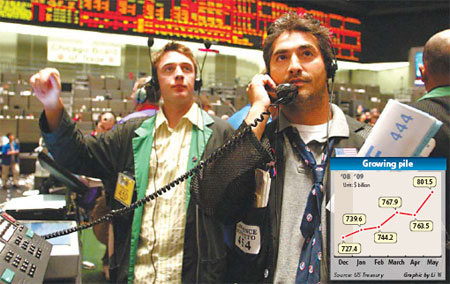
Updated: 2009-07-18 09:19 China, the biggest foreign holder of US Treasuries, increased its holdings of US government notes and bonds by $38 billion to $801.5 billion in May, according to a US Treasury report released on Thursday. The total amount, which exceeds $800 billion for the first time, was equivalent to 37.6 percent of its $2.13 trillion foreign exchange reserves then. On the contrary, Japan, Russia and Canada were sellers of US assets in May. Japan, the second-biggest international investor, reduced its total holdings by $8.7 billion to $677.2 billion.
"The surge in May does not mean that China will continue buying more US debt in the future," said He Maochun, director of the Research Center of Economy and Diplomacy of Tsinghua University.
China previously announced it would buy $50 billion worth of bonds denominated in Special Drawing Rights, the International Monetary Fund's unit of account, to be issued by IMF. Russia and Brazil have committed to $10 billion each. "China does not have a better option than the US Treasuries, which are relatively secure compared to other options," he said. Li Lianzhong, who heads the economics department of the Central Policy Research Office, said earlier that China should use more of its foreign exchange reserves to buy gold, energy and natural resources assets. Li cited the high percentage of gold in the foreign exchange reserves of the United States, Italy, Germany and France, to argue that China's gold holdings, which accounted for about 1.6 percent of its reserves, are too small. In addition, he believes that China should consider buying good overseas companies and also acquire technologies during the economic crisis. The Obama administration is counting on countries like China to finance its expensive $787-billion economic stimulus and China has expressed concern about the prospects for the country's economy and the health of its investment. "We have lent a massive amount of capital to the United States, and of course we are concerned about the security of our assets," Premier Wen Jiabao said during a March 13 press conference. "To speak frankly, I do indeed have some worries," he said. Experts also suggest that the country should reduce the size of its trade surplus, either by importing more from other countries or by doing more overseas investment. "We understand China's currency policy is aimed toward an eventual balance between inflows and outflows. But for now, inflows are dominant," said Patrick Bennett, Asia Foreign Exchange & Rates Strategist with Societe Generale in Hong Kong. Bennett believes that a modest appreciation of the Chinese yuan would also work to slow inflows and would be a damping influence on the trade surplus. |
肇州县| 彰化市| 汝南县| 赫章县| 石家庄市| 鸡东县| 福建省| 天台县| 宝应县| 抚松县| 敦化市| 昌图县| 板桥市| 大荔县| 河池市| 亳州市| 四子王旗| 固安县| 施秉县| 荆门市| 句容市| 普洱| 华蓥市| 莱芜市| 迁安市| 蓬溪县| 丽水市| 湾仔区| 湘乡市| 响水县| 韩城市| 夏邑县| 高雄市| 广昌县| 兴海县| 高唐县| 庆城县| 乐安县| 合阳县| 庐江县| 合江县|