|
|

2009 SCO & BRIC Summits > SCO Observer States
|
Mongolia(sectsco.org)
Updated: 2009-06-11 16:30
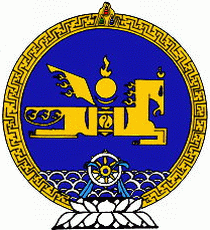
Mongolia is in central Asia and covers 1,564,100 sq km. It is the world's nineteenth-largest country with a population of more than two and a half million. It shares a 3,485 km border with Russia to the north and a 4,677 km border with China to the south. From west to east, the country is 2,392 km; from north to south it is 1,259km. The average altitude is 1,580 meters above sea-level, and Mongolia is a landlocked country. The capital of Mongolia is Ulan Bator. The head of state is the President of the Republic of Mongolia (currently Nambaryn Enkhbayar), elected by the direct national election every four years. The President cannot be re-elected after two successive terms.The President is also the Commander-in-Chief of Armed Forces of the country. Mongolia is a parliamentary republic. The current Constitution of Mongolia was adopted on January 13, 1992, and went into effect on February 12, 1992. The parliament is elected by the people and in turn elects the government. Mongolia's constitution guarantees full freedom of expression, religion, and others. Mongolia has a number of political parties, the biggest ones being the Mongolian People's Revolutionary Party (MPRP) and the Democratic Party (DP). Mongolia consists of 21 aimags (provinces), which are in turn divided into 315 sums (districts). The capital Ulan Bator is administrated separately as a khot (municipality) with provincial status. The official language of Mongolia is Khalkha Mongolian, which uses the Cyrillic alphabet, and is spoken by 90 percent of the population. A variety of different dialects are spoken across the country. In the west the Kazakh and Tuvan languages, among others, are also spoken. The Russian language is the most frequently spoken foreign language in Mongolia, followed by English. Mongolia's economy is centered on agriculture and mining. Mongolia has rich mineral resources, and copper, coal, molybdenum, tin, tungsten, and gold account for a large part of industrial production. Industry currently accounts for 21.4 percent of GDP, approximately equal to the weight of the agriculture sector (20.4 percent). These industries include construction materials, mining (coal, copper, molybdenum, fluorspar, tin, tungsten, and gold), oil, food and beverages, processing of animal products, and cashmere and natural fiber manufacturing. |
       |
泰顺县| 田东县| 蒙山县| 贵州省| 类乌齐县| 河津市| 哈尔滨市| 宣武区| 南郑县| 嘉祥县| 民和| 永仁县| 安庆市| 策勒县| 华容县| 吉林市| 扶绥县| 乌审旗| 靖西县| 新平| 老河口市| 海淀区| 宜昌市| 且末县| 文登市| 克拉玛依市| 大方县| 隆尧县| 会同县| 台东市| 吉林市| 菏泽市| 天全县| 中西区| 金湖县| 大英县| 维西| 湟源县| 六安市| 普格县| 西宁市|