|
|

NPC & CPPCC > About NPC and CPPCC
|
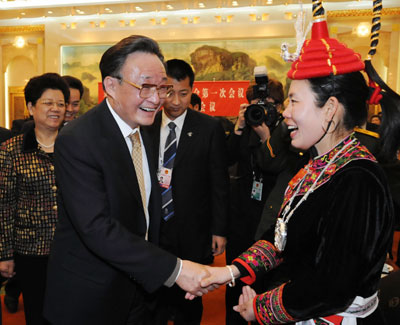
First CPPCC sessions, leadersBy (Xinhua)
Updated: 2009-03-02 16:04 BEIJING -- China is to reshuffle its central departments under the State Council, the cabinet, with a draft restructuring plan submitted to parliament for deliberation on Tuesday. It will be the sixth such institutional reform aimed at building an efficient and service-oriented government. Following are the five major government reshuffles over the past three decades: -- 1982: The number of ministries and commissions, organizations directly under the State Council, and functional offices was reduced from 100 to 61, and staff members reduced from 51,000 to 30,000. This reform did away with life tenure for leading cadres and promoted younger officials, which was hailed as a major breakthrough. But it did not touch upon the highly-concentrated administrative system of planned economy and failed to transform government functions. -- 1988: The number of ministries and commissions was reduced from 45 to 41, organizations directly under the State Council reduced from 22 to 19, and staff members reduced by 9,700. This reform focused on pushing for transforming government functions and restructuring those cabinet agencies closely linked with economic system. But the streamlined agencies swelled again soon after the reform due to overheated economy. -- 1993: The number of ministries and commissions, organizations directly under the State Council, and functional offices was reduced from 86 to 59, and staff members reduced by 20 percent. The core task of this restructuring was to build an administrative system with Chinese characteristics that adapted to the system of socialist market economy. Transformation of government functions remained to be the focus of this reform. -- 1998: Fifteen ministries and commissions were axed, three were renamed, and four new ministries and commissions were set up. The number of ministries and commissions was reduced from 40 to 29 after the restructuring, not including the General Office of the State Council.The four new ministries and commissions were: the Commission of Science, Technology and Industry for National Defense, Ministry of Information Industry, Ministry of Labor and Social Security, and Ministry of Land and Resources. This reform was to establish a highly efficient, well coordinated and standardized administrative system, improve the state system of civil servants and set up a high-calibre, specialized contingent of administrative personnel. Competition for positions and job rotation in government departments were popularized after the reform across the country. -- 2003: The State-owned Assets Supervision and Administration Commission, China Banking Regulatory Commission, Ministry of Commerce, State Food and Drug Administration, and State Administration of Work Safety were set up or re-grouped as new cabinet agencies. The State Development and Planning Commission was renamed as the National Development and Reform Commission, and the State Family Planning Commission was renamed as the State Population and Family Planning Commission. The number of ministries and commissions was reduced from 29 to current 28 after the restructuring, not including the General Office of the State Council. This reform helped strengthen the supervision and macro-regulation functions of the government, improve service functions and clarify functions of different cabinet agencies.
Will the country's first law on food safety adopt zero tolerance toward either food manufacturers or other affiliated sectors that pose threats to people's health?
|
       |
肥西县| 栾川县| 濮阳县| 宝鸡市| 吴堡县| 深圳市| 沾化县| 临安市| 蚌埠市| 舒兰市| 布尔津县| 德清县| 宿州市| 汽车| 博乐市| 安宁市| 蓬莱市| 行唐县| 纳雍县| 高安市| 忻州市| 紫金县| 嵊泗县| 古浪县| 金乡县| 兴隆县| 祥云县| 梅河口市| 青铜峡市| 湖北省| 涞水县| 郴州市| 左云县| 商水县| 离岛区| 卢氏县| 库车县| 阜新市| 昭平县| 商南县| 调兵山市|