Society
Laws to be tightened for 'stem cell tourists'
By Todd Balazovic (China Daily)
Updated: 2009-12-24 07:42
 |
Large Medium Small |
"Given high health risks, the WHO does not recommend clinical trials on foreign medical tourists, who may be vulnerable to abusive practices."
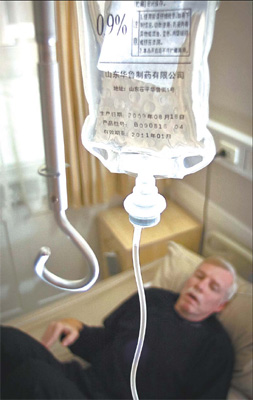 Richard Jewell, 54, an American sufferer of Parkinson's disease who has paid more than $30,000 for stem cell treatment, waits in his room in Tiantan Puhua Hospital in Beijing. [Jonah M. Kessel/China Daily] |
Thomas returned to Tiantan Puhua Hospital this month with her friend Richard Jewell, 54, a fellow Parkinson's sufferer who plans to undergo the same stem cell treatment.
Jewell, who worked as a park ranger alongside Thomas in Colorado, said the decision to come to China was difficult but he was willing to do almost anything to improve his quality of life.
"I've spent my life savings to come out here. I wish I could have just had this treatment in the US," said a nervous Jewell, who talked to China Daily four days before the start of the
5-week course. He said he paid almost 220,000 yuan for the treatment.
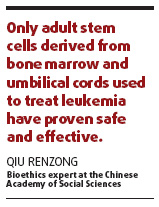
The fact people are willing to go to such extreme lengths highlights the need for stricter regulations and supervision, argued Qiu, who also sits on the health ministry's national ethics committee.
"The rules issued in May do not go far enough. The ethics committee is now drafting guidelines in which all adult stem cell treatments, except the already confirmed treatment of leukemia, must pass clinical trials after they get approval from State Food and Drug Administration," he said.
The clinical trials could take as long as five years to complete, he added.
His call for stricter rules was supported by a report released in September by Bionet, a panel of 30 Chinese and European doctors, lawyers and bioethicists. The report, which was three years in the making, called for a global clampdown on all stem cell treatments.
For Qiu, one of the authors of the Bionet report, the biggest concern is for people like Jewell who fly across the world and spend large sums of money on a treatment that may not even work.
"Today they feel better, tomorrow they may feel worse. Even if their symptoms disappear, was it because of the injected stem cells or simply by natural recovery? The method these doctors use now is trial and error. They promise nothing," said the professor.
Despite Qiu's concerns, Thomas said the treatment is continuing to work for her three years on. "If I had the chance to do it again, I would do it in a heartbeat," she said.
For doctors at places like Tiantan Puhua Hospital, where Thomas and Jewell were treated, the health ministry's new regulations have received mixed feelings. While medics nationwide readily support the legislation, many working at centers that have offered the stem cell treatments for more than five years fear they will be forced to halt the procedure if they cannot pass clinical trials, regardless of any documented success. Hospitals were scrambling to prepare applications in November for government approval to carry out the treatments.
Vivian Wang, marketing manager for Tiantan Puhua Hospital, said she hopes the authorities will recognize not all clinics operate under unsafe, unproven conditions, but admitted that hospital executives were "nervous" about the regulations.
"I'm afraid the government will close down all of the clinics," she said, adding that hospitals could only wait to see if they get the green light to continue offering the service.
"We really don't know how long it will take the government to finish their checking procedure."
Wang has been working with doctors since the beginning of the year to gather the necessary materials to prove the treatments are successful. She said they have prepared documents outlining previous cases, an in-depth report on how they conduct the treatments, information on specific cases and research on how stem cells can be used to treat specific diseases.
"We will give the application to a team of government specialists, who will look it over and then visit our hospital," said Wang. "They will decide if we get a license or not."
But the guidelines to determine suitable clinics have yet to be defined, said Bo Cheng, deputy director of business development at the Beijing-based Wu Stem Cells Medical Center, which specializes in stem cell implantation.
"Nobody knows the criteria yet, but everyone that applied must think they meet the standard," he said.
Hospitals that do not make the grade will be barred from carrying out the treatments, possibly making it harder and more expensive for people like Thomas and Jewell to get the help they desperately want.
Shan Juan contributed to the story