Society
Bilingual education in Xinjiang bridging gaps
By Cui Jia (China Daily)
Updated: 2009-12-17 08:16
 |
Large Medium Small |
URUMQI: By 2012, the central government will have invested 4.02 billion yuan ($591 million) in bilingual kindergarten education in the Xinjiang Uygur autonomous region in an attempt to encourage preschool children from ethnic minorities to learn Mandarin in addition to their own language.
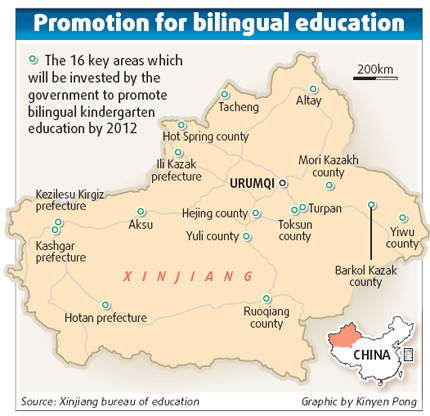
Kashgar region, Hotan prefecture, Aksu prefecture and Turpan city are among the 16 key areas targeted by the program that will promote bilingual education among students aged 5 to 7 years, according to a statement released by the region's bureau of education yesterday.
A total of 349,100 children from ethnic minority groups will be educated in bilingual kindergartens by 2012.
"The central government has already invested 1.2 billion yuan since 2008 on building bilingual kindergartens and promoting preschool bilingual education in the region," Dai Xiang, deputy director of the Xinjiang Bilingual Education Guiding Office, told China Daily yesterday.
"The regional government will use the rest of the investment to build and fund 2,237 more bilingual kindergartens in two years."
A total of 214 bilingual kindergartens funded by the central government have come into use this year in southern Xinjiang, a hotbed for terrorist activities that led to the July 5 riot in the regional capital of Urumqi, Dai said.
The July 5 riot saw at least 197 people killed and more than 1,700 injured.
Police sources say overseas forces seeking Xinjiang's independence through terrorism were behind the riot.
Dai said many of the new bilingual kindergartens will be built in rural areas.
"The parents don't need to pay tuition because the cost of their children's education and even meals at the kindergartens will be completely covered by the central government," Dai said. "That's why the parents all want to send their children to those kindergartens."
In addition to learning Mandarin, the children will be prepared for elementary school, Dai said.
"I cannot speak Mandarin and that is something I always regret," said Enimar, whose 9-year-old daughter, Qimaiduo, studies at a village bilingual elementary school in Aksu region, southern Xinjiang.
Enimar said he did not think a knowledge of Mandarin would mean students would use their ethnic languages less, or that they would lose their heritage.
"Instead, mastering Mandarin can help us to promote our culture," he said.
Authorities hope bilingual education will help bridge communication divides among people in Xinjiang, where 60 percent come from ethnic minorities, including Uygur, Kazak and Mongolian.
Bilingual education in the region, which started in 1992, aims to improve the standard of Mandarin among ethnic minority graduates, so they could be more competitive in the workplace. Bilingual kindergartens, which were first set up in 2004, are expected to accentuate the trend, Xinjiang's regional government chairman Nur Bekri said earlier.
At present, more than 600,000 students from ethnic minority groups in Xinjiang are participating in the bilingual education initiative, accounting for a quarter of all minority students.