Society
Four-legged therapists
(China Daily)
Updated: 2009-12-10 08:04
|
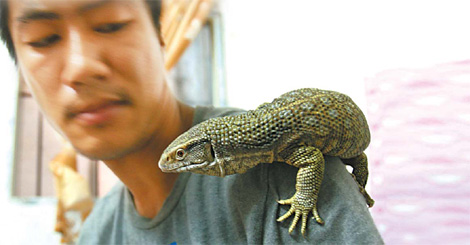
Zhao Jing, from Wuhan, Hubei province, with his pet lizard. Shi Yi |
Dogs, cats and other four-legged friends are true miracle workers. It's not just their enthusiasts who say so. There's a long list of medical proof showing their therapeutic benefits to people.
Just having a pet around reduces stress and, thus, the likelihood of disease. Dogs keep their owners on the move. Animals can help children learn responsibility. They are sometimes better than therapists for certain mental and physical problems.
But it all only works under one condition: The person has to accept the animal. That's the way Reinhold Bergler, a German psychologist and head of the Research Circle on Animals in Society, puts it. Anyone who doesn't like animals or is scared of them, gets no benefits from having pets around. Similarly, children who just let their guinea pigs linger in their cages learn nothing about responsibility.
"What's important is a proper approach," he says. Otherwise, the pet might develop a behavioral problem, making any benefit from the animal-human relationship impossible.
It's no secret that animals are good for people. As early as the 18th century, monks in the York monastery relied on both prayer and animal accompaniment in attempts to treat mental illness. Those positive results have been confirmed by multiple studies since.
"Healthy and sick people both benefit from the multiple facets of the human-animal relationship," reads a report from the University of Zurich.
But what is it about animals that helps people? The list is long. "Animals open up new worlds," says Graham Ford of Tiere helfen Menschen, a German group devoted to using pets in treating humans. Group members visit old folks' homes, hospitals and kindergartens accompanied by an animal, usually a dog.
Reactions are generally positive. Old people who normally sit silent in front of the television can suddenly become much more communicative when an animal is around because they experience that a living being is approaching them without reservation, enjoys their attention, and makes them happy in return.
Small animals can have a huge impact. In one study, 200 people in an old folks' home were assigned the care of a budgie for eight weeks. "At the end of that period, no one wanted to give up their bird," says Bergler.
Additionally, the mood in the home improved as the elderly folks had something to discuss with one another and something to do.
Similar positive results come from a study pairing dogs with the long-term unemployed. The dogs proved to be a boon. "The dog made sure there was a structured day. The human can't just goof off all day and sit in front of the TV," says Bergler.
|
Two kids from Hainan Island play with a tortoise. The therapeutic benefits of pets to people are well documented. Meng Zhongde |

In similar ways, dogs make sure their masters don't sink into depression. "They guarantee daily activity, light and social contact," says Eckart von Hirschhausen, a Berlin-based doctor and author. Dogs can even empathize with people.
People with a dog bounce back faster from illnesses. That's because animals, especially dogs, are helpful in motivating and mobilizing sick people. One study showed that people recovered from heart surgery much faster if they owned a pet. Simply taking a dog on a walk helps lower blood pressure and cholesterol.
A recent Daily Express report said a survey of 5,000 Britons, conducted by a pet healthcare company, showed that dog owners get more exercise walking their pet than people who go to gyms.
Two dog walks a day, each lasting 24 minutes, and three longer walks a week, each lasting 30 minutes, give pet owners seven hours' exercise a week, said the report.
Those without a dog spend an average of just one hour and 20 minutes a week exercising by going to the gym or walking or jogging.
Even just petting an animal - or enjoying its presence - can help lower pulse rate and blood pressure.
Australian doctors have shown that animals help reduce illness. Their study showed that dog owners visit the doctor much less frequently than people without pets. The study showed that cat ownership has an even greater influence on human health.
Whether a dog, cat, guinea pig or budgie, all help people to feel less alone. "They make up for human contact," reports a study from Switzerland. Pet ownership can also improve interaction between humans by giving people something to talk about. By just being around, animals reduce the likelihood of people fighting.
Children don't just learn to love animals through pet ownership, but also about building ties to other humans. "Parents should pick house pets on the basis of which ones will help their children learn responsibility and empathy," says Hirschhausen. That means furry animals that show feelings are also better than some, like turtles, which "just look out from under their shell and munch on lettuce".
DPA