CHINA> National


|
CHINA> National
|
|
Related
Scholar: Japan should show more tolerance and confidence
By Zhang Xin (China Daily)
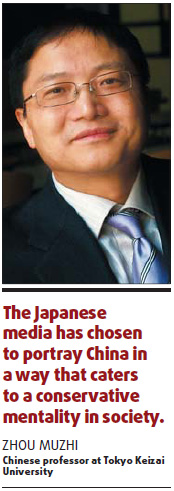
Updated: 2009-11-02 10:22 Japan needs to boost its tolerance and confidence in engaging China and its people to promote bilateral ties, particularly at the grass roots, Zhou Muzhi, a Chinese professor at Tokyo Keizai University, told China Daily in an interview.
Zhou, who has studied, worked and lived in Japan since 1988, said the attitude of Japanese society toward China has seen a delicate shift - simultaneous with the ups and downs in Sino-Japan relations in the last decade, as well as affected by Japan's economic situation and its position in the region and the world. Japan had been nurtured by an irrational "China threat mentality" as its neighboring country China experienced rapid growth in its economy and society, Zhou said. China's previously unimaginable progress startled its neighbor, compared with a stagnation in Japan, triggering a "lack of confidence and intolerance" in Japan that resulted in a fear of China's growth. These could be seen in media reports of China in Japan, Zhou said. "The Japanese media has chosen to portray China in a way that caters to a conservative mentality in society," Zhou said, citing coverage of the tainted dumplings cases as an example. "A large number of Japanese people cannot really understand the real China," he said. Last January, more than 10 people in Japan reported stomachaches, vomiting or diarrhea after eating frozen dumplings made in China. A thorough investigation by Chinese authorities showed that an individual had deliberately caused the poisoning and the incident was not a lapse in food safety resulting from pesticide residue, as many in Japan had assumed. The fanning of one-sided media reports in Japan subsequently hurt the reputation of Chinese food products in Japan and caused a slump of China's food exports to Japan. Zhou added there have also been a good number of media reports exaggerating China's pitfalls and demonstrating "China as a country set to fall", all based on their own assumptions.
Still, Zhou said Japan continues to show less confidence to engage people from China in a number of other instances. Admitting foreign students into Japan in the last few years has become less flexible than years ago, he said. Educational statistics have shown that the number of Chinese students heading for Japan has declined in the last few years. In 2008, 14,160 students went to study in Japan, recording a 150 percent decline from 2004. "It is more difficult for Chinese students to be issued a visa to study in Japan and the process got more complicated with the finger-printing process," Zhou said, adding that many Chinese students in Japan have to wait for years before getting credit card applications approved. The university professor also said that in the university, scholarship and job opportunities, once open for grabs, are now very limited compared to years ago. "This may be a reflection of Japan being less open-minded and engaged," Zhou said. But he said the new Japanese government, headed by Yukio Hatoyama that was elected by the public amid hopes for a stronger economy and better living standards, should also bring about more confidence and tolerance among Japanese people to engage China with a positive mentality. |
南安市|
卓资县|
淄博市|
婺源县|
潜山县|
香河县|
师宗县|
东乡县|
北京市|
大足县|
宁国市|
西城区|
丹巴县|
海宁市|
玉门市|
东乡县|
吉木乃县|
铜梁县|
玉环县|
西乡县|
成武县|
锡林郭勒盟|
高清|
黄冈市|
天津市|
福鼎市|
左贡县|
乌海市|
溆浦县|
陇西县|
辽阳市|
濮阳县|
陆良县|
武乡县|
淮北市|
田阳县|
青铜峡市|
大庆市|
汝州市|
麦盖提县|
浮山县|