CHINA> Focus

|
CHINA> Focus
|
|
On red alert
By Zhang Xi (China Daily)
Updated: 2009-09-29 08:38 When Zang Na was told her friends were planning to marry, she was naturally over the moon - but her excitement was quickly replaced by dread when she received invitations to seven wedding banquets ahead of the National Day holidays. 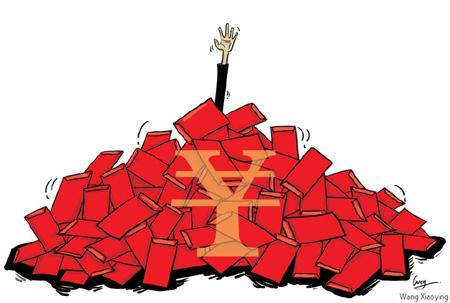 Together, these extravagantly designed invites promised a devastating blow to her savings over the "golden week" break.
Hong bao is given on special occasions, such as Spring Festival, weddings and birthdays, and is a ritual mentioned in books from as far back as the Qing Dynasty (1644-1911). Red is lucky in Chinese culture but, when it comes to the envelope ritual, those on a tight budget would be forgiven for seeing it, as the West does, as meaning danger. "If you get invited you have to pay up," said Yu Nan, 25, a Beijing IT technician, who earns less than 5,000 yuan a month and complained that, no matter how empty his wallet is after paying his mortgage, he still could not avoid the ritual.
"Last month was a nightmare. I had to attend 11 wedding ceremonies and gave out more than 10,000 yuan. I even had to borrow cash from colleagues to fill the envelopes," he added. Despite its long history, the tradition disappeared for a time in the 1950s, shortly after the founding of the People's Republic of China, when people simply gave xi tang, or wedding candy, instead of expensive gifts. "My uncle married during that period and he and his bride-to-be just invited friends and relatives to chat and eat wedding candy in their new home," recalled Xiao Lin, a 50-something from Luoyang, Henan province. "However, couples started to receive gifts again in the shape of life necessaries, like wash basins, in the 1960s." By the late 1970s and 80s, hong bao was back. "I tied the knot in 1980 and some of my colleagues gave up to 10 yuan. The average wage was just 40 to 50 yuan at the time, which means these people handed over a quarter of their salary," said Liu Min, a 46-year-old from Shenyang, Liaoning province. |
|||||||
门头沟区| 聊城市| 元朗区| 屏东市| 渭源县| 汝南县| 建德市| 阜康市| 揭东县| 葫芦岛市| 桃园市| 德庆县| 辽宁省| 绿春县| 肥西县| 砚山县| 四平市| 大竹县| 大城县| 梅州市| 关岭| 唐河县| 台东县| 商河县| 宝鸡市| 方山县| 汶上县| 芦山县| 兰坪| 通州市| 桃源县| 禄丰县| 金平| 敦化市| 泸溪县| 华阴市| 望都县| 肥东县| 兖州市| 绵竹市| 太白县|