CHINA> National

|
CHINA> National
|
|
New Great Wall ruins discovered in NE China
(Xinhua)
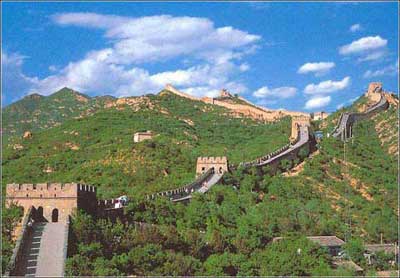
Updated: 2009-09-22 17:30 CHANGCHUN: Chinese archaeologists have discovered a section of ruins of the Great Wall of Qin (221 BC and 206 BC) and Han (206 BC and 220) dynasties in northeast China's Jilin Province, which proves the defensive wall stretches eastward further than previously thought. "The site was found in Tonghua County, Jilin, 10.9 km eastward of what was previously thought to be the eastern end of the Great Wall in Xinbin County in neighboring Liaoning Province," said Zhao Hailong, head of the Great Wall resources research team in Jilin, on Tuesday. He said the team's research was a part of a national project to measure the length of the Great Wall of the Qin and Han dynasties. The project is jointly sponsored by the State Administration of Cultural Heritage and the State Bureau of Surveying and Mapping. It is generally believed that the Great Wall was built in different historic periods and adds up to about 50,000 km.
The two government departments announced in December 2008 the exact length of the Great Wall built in the Ming Dynasty (1368-1644) was 8,851.8 km, after conducting a first phase national survey of the Wall. The two departments are expected to announce the results of the second phase of the survey by the end of this year. It focuses on the measurement of the total length of the Great Wall built in the Qin and Han dynasties based on the latest discoveries. Archaeologists worldwide have generally agreed this part is about 6,000 km.
A large quantity of Han Dynasty earthenware was unearthed at the site, which has been called by archaeologists the "Nantaizi Relics". "The site is probably a fortification of the ancient city of Chibosong, which is 27.9 km away. It is important evidence of the Han Dynasty's administration of the northeast part of the country, " said Zhao. He said there might be more forts in the 10.9-km distance between the new site found in Tonghua and what was previously thought to be its ending in Xinbin. "However, it is a meagerly-populated area covered by dense forest and it is difficult to conduct archaeological surveys there," he said. |
||||||||
桐梓县| 安塞县| 雷山县| 日喀则市| 德令哈市| 峨眉山市| 渝北区| 辉县市| 穆棱市| 台南县| 会理县| 靖江市| 甘德县| 郓城县| 沁源县| 鲁甸县| 即墨市| 皮山县| 上高县| 略阳县| 吉水县| 当雄县| 金坛市| 昂仁县| 安达市| 宜州市| 怀来县| 固始县| 兴海县| 启东市| 衡阳县| 江达县| 盘山县| 鹤峰县| 稻城县| 元江| 灵璧县| 兴文县| 蒲城县| 正定县| 莱阳市|