CHINA> National

|
CHINA> National
|
|
US pork exports languish as demand wanes in China
By Li Xiang (China Daily)
Updated: 2009-09-05 11:05 China's plummeting demand for imported pork amid concern over A(H1N1) flu is adding a further blow to the recession-stricken industry in the United States, which has seen continuous losses over the past two years.
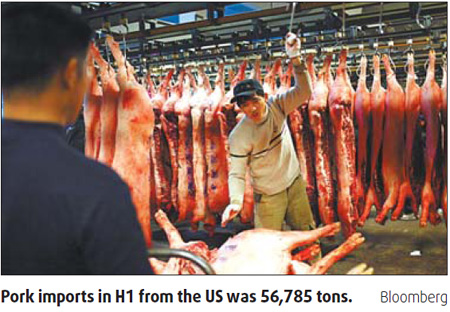
A(H1N1) is commonly known as swine flu. It is one of the primary reasons for the drop in China's demand for imported pork although scientists have said there is no evidence that the flu can be contracted through pork consumption. The Chinese government has taken restrictive measures against imported pork from A(H1N1) flu-affected areas including the US and Canada since the outbreak of the disease. In August, China banned imports of American meat from three pork plants in the states of North Carolina, Iowa, and Oklahoma, Reuters reported. Some American pork producers are now leaving the industry and selling their mother pigs, causing the pork sector in the US to undergo a significant contraction in production. "Mostly economists now say that we probably need to reduce the size of sow numbers by at least 5 or 10 percent and maybe even more than that. That's a pretty significant contraction," Caspers said. Caspers said the industry was continuously losing money almost every month since the fall of 2007 because of diminishing demand and soaring feed cost. Some of the larger pork producers that are struggling have called for government assistance. The Obama administration recently said it would buy $30 million in pork products in fiscal 2009 for federal foods programs. "But that's a pretty small amount. It helped but it's not anything that's going to really change things," Caspers said. China imported 56,785 tons of pork from the US in the first six months of 2009, 70 percent down from the same period last year. Insiders said last year's surge of imported pork from the US was largely due to the high domestic price and increasing demand in China before the Beijing Olympics. But the imports soon took a nosedive after the outbreak of A(H1N1) flu, which was labeled a pandemic earlier this year. A recent survey by the USMEF on Chinese consumers showed that 22.1 percent of those surveyed still believe that the H1N1 virus can be contracted by eating pork even months after the initial outbreak. "H1N1 is still a concern. It may not be as much of a concern as it was in April and May, but still some consumers have confusions over H1N1 and its relation to pork products," said Joel Haggard, a senior vice-president of the USMEF. China is both the world's largest producer and consumer of pork products. In 2008, China produced 46.2 million tons of pork, accounting for 45 percent of total output of world pork production. Despite China's high self-sufficiency rate in pork production, it still imports a considerable amount of pork each year from the US, the EU and Canada, which are the three top pork exporters to China. Last year China imported a total of 932,000 tons of pork, figures from the China Meat Association (CMA) showed. Although China has slowed down its meat imports in recent months, experts say the market will remain open in the future. |
隆子县| 铁岭市| 拉孜县| 佛教| 泾川县| 广平县| 镇原县| 武功县| 祁阳县| 德兴市| 武乡县| 商南县| 贵港市| 平湖市| 彩票| 砚山县| 梧州市| 兰溪市| 玉树县| 邵东县| 长治县| 榆林市| 南昌县| 买车| 济源市| 神池县| 泸州市| 建宁县| 祥云县| 灌南县| 天柱县| 兴安盟| 保康县| 青海省| 辽宁省| 吴川市| 定西市| 遂昌县| 正安县| 河东区| 福清市|