CHINA> Focus

|
CHINA> Focus
|
|
Rewriting the rules of language triggers controversy
By Chen Siwu (China Features)
Updated: 2009-08-28 10:29
Even computer firms would have to update the relevant characters in word processing and other software packages. Officials at the Ministry of Education, who revealed the experts and academics that compiled the new character list made 90 revisions during 80 special meetings over eight years, insisted the proposals are in line with the standards of the country's 2001 law on Chinese language. "The readjustment is to be made for the sake of facilitating information storage, management and exchange," said Li Yuming, director of the ministry's department of language information management and deputy director of the State Language Commission. He said all 44 frequently used characters have already been digitalized in computer software and can be easily printed. "The slight amendments will not affect the lives of ordinary people and it will do good to the standardization of the printing," he said.
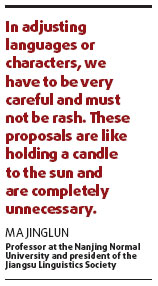
If the backlash that followed the suggestion to change the name of Shijiazhuang, capital of Hebei province, this month is indication, however, Chinese citizens may take some convincing. Chen Yujian, deputy director of the city's bureau of science and technology, proposed a switch to the name "Zhengding" but the response from residents was so overwhelmingly against the move city government officials held a press conference to deny the idea had ever been mooted. The feedback from the public, particularly netizens, over the possible changes to the 44 characters has so far been very different from the government's reported response. An online poll last week by Sina.com, a major Chinese news portal, which attracted 531, 000 respondents, showed 91 percent opposed the revision, with only 4.5 percent in favor. "This is funny," wrote Xiong Peiyun on the Beijing News's opinion-editorial page on Sunday. "How can the results of ministry's statistics and the online survey be so different? "Which has more samples? More importantly, which represents the majority?" Ma Jinglun, a professor in Chinese language at the Nanjing Normal University and president of the Linguistics Society in Jiangsu province, said he was strongly against revising the 44 characters.
"In adjusting languages or characters, we have to be very careful and must not be rash. These proposals are like holding a candle to the sun and are completely unnecessary." During the Warring States Period (475-221 BC), the prime minister of Qin, Lu Buwei, hung his works The Spring and Autumn Annals of Lu (Lu Shi Chun Qiu) at the city gates of Xianyang, now Xi'an, and vowed to award 1,000 pieces of gold to anyone who could add or delete a character from the book. Lu later helped Qin Shihuang unify the nation and become the first emperor of China, but it was his "precious" promise and the popular phrase it coined that is his obvious legacy today. |
||||||||
西乌珠穆沁旗| 诸暨市| 景东| 平湖市| 宁海县| 开化县| 宝山区| 永吉县| 敦煌市| 柳州市| 灌南县| 五家渠市| 晋宁县| 凭祥市| 沛县| 木里| 平武县| 克山县| 舟曲县| 咸丰县| 凉城县| 桂平市| 宁德市| 延川县| 仙游县| 永平县| 湖州市| 仲巴县| 峡江县| 青铜峡市| 东阿县| 宕昌县| 祁门县| 榆中县| 法库县| 来凤县| 类乌齐县| 舟山市| 得荣县| 房山区| 平湖市|