Hot on the Web
Han Han: Voice of the post-80s generation
By Wu Chen (China Features)
Updated: 2009-08-20 10:13
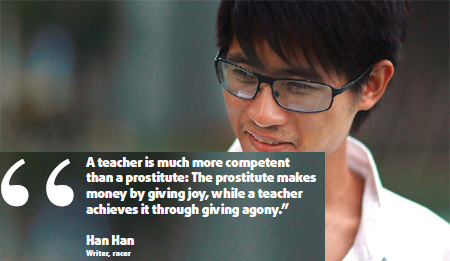 At 27, Han Han is one of China's most successful bloggers. [Photo by Zhou Yunzhe/China Daily] |
When Han Han flipped the bird at judges after receiving a penalty during the China Touring Car Championship in June, many wondered if he'd taken his penchant for controversy too far.
The 27-year-old professional racecar driver later posted on his blog, lambasting the Federation of Automobile Sports as "unprofessional" in rule enforcement and criticizing it for failing to impose penalties for prohibited pre-rally road surveys.
Asked whether he had considered his obscene gesture's influence on society, Han sarcastically responded: "The only group that might be affected is children, but I believe that with the protection of 'Green Dam' (filtering software blocking violent and pornographic Internet content), they won't be hurt."
It was the sort of sharp comment that has made Han China's most popular blogger -- and one hailed as the voice of his generation.
Han's blog is known for attacking the establishment, and his opinions often make headlines - that is, if they pass the censors.
His thoughts on the fire that destroyed a new tower block owned by State broadcaster China Central Television (CCTV) in February disappeared from the Chinese Internet soon after they were posted.
|
||||


He voiced the frustrations of his generation in the post: "The government needs to think about a serious issue: Its mouthpieces damage the image of their master when they operate under the current mechanism. Even a truthful story can appear fake when they are the ones reporting it.
"The younger generation has been maturing and will ridicule what these State-owned media agencies produce more and more ... No wonder they (the media) are being left behind by the times."
He also pointed to the reasons for his own popularity: "This is an era in which you cannot convince people unless you have virtue."
In late May 2008, when American actress Sharon Stone triggered outrage in China by saying the Sichuan earthquake was "interesting" and "karma", Han argued that Stone's original meaning was distorted by the media.
He put the full quote and direct translation in his blog, saying Stone was explaining her thought process, but the media quoted her out of context.
Three days later, he posted a 3,000-word article entitled Don't Show the Fury of the Whole Nation, advising the public to ease their nationalist ardor.
"A sentence from a passe foreign star misquoted by the media made us show our savage side," he wrote, referring to postings calling for her to be "killed" or otherwise harmed.
"If we think about what we've said after natural disasters in other countries, we will find we are far from real humanitarians. If you don't reflect on the past, you are not as good as Stone. She at least knew enough to reflect on herself," the post read.
He also said Chinese should focus on more important matters, such as the "tofu-built" schools that collapsed in the quake.
For this he was branded an "idiot", "cold-blooded" and "unpatriotic" on Chinese websites.
In fact, he had gone to Sichuan right after the quake to distribute relief materials he and his friends personally donated, but he cautiously avoided the cameras so as not to be branded a "showoff".
Lu Jinbo, Han's publisher, and Leung Man Tao, a commentator with Hong Kong-based Phoenix TV, agree that Han might be the next Lu Xun (1881-1936), arguably the most famous modern Chinese writer, who was acclaimed for his vehemently critical essays.
As a post-'80s author, Han gained fame when his first novel Triple Gate (San Chong Men) was published in 2000. The book is about a high school student's campus life.
In it, Han -- then only 18 -- attacks the educational system, by comparing teachers who do home schooling with prostitutes.
"Teachers are not popular, but home schooling is. From that, we can see that teaching is like dating," he wrote.
"One to many is cheap, but one to one is precious -- almost the same price per hour as a prostitute.
"However, a teacher is much more competent than a prostitute: The prostitute makes money by giving joy, while a teacher achieves it through giving agony."