CHINA> Regional

|
CHINA> Regional
|
|
Related
Air pollution may cause severe drought in north
By Wang Hongyi (China Daily)
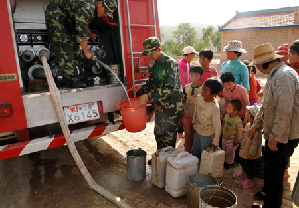
Updated: 2009-08-17 06:59 As severe drought threatens crops in northern China, a new study has suggested air pollution could be reducing valuable rainfall. "Besides the health effects, acid rain and other problems that pollution creates, this work suggests that reducing air pollution might help ease the drought in North China," said lead researcher Yun Qian. About 2.5 million hectares of crops are seriously affected by the drought and may face crop failure in the provinces of Liaoning, Jilin, Heilongjiang and Shanxi and in the Inner Mongolia autonomous region, the ministry of agriculture said over the weekend. Autumn grain output accounts for more than 70 percent of the country's total grain output.
He Lifu, chief forecaster of the National Meteorological Center, said expected rainfalls in drought regions from Monday to Wednesday may alleviate the disaster. According to the study published in the Journal of Geophysical Research, air pollution in China's industrial east appears to have significantly reduced light rainfall over the past 50 years, raising the possibility that cutting pollution could ease a severe drought in the country's northeast. Light rain - anything from a drizzle to 0.4 inches (10 mm) in a day - is also critical for agriculture, as opposed to heavy rain, which triggers floods that can wash away crops. Researchers from the US Department of Energy's Pacific Northwest National Laboratory found that the number of days of light rainfall decreased in China by 23 percent due to air pollution between 1956 and 2005. The study could also help further the understanding of how aerosols - tiny air particles caused naturally and by human activity such as burning fossil fuels - affect the formation of rain clouds, researchers said. The number of water droplets in clouds is higher when there is a greater number of aerosols, but the study found water drops in polluted areas are up to 50 percent smaller than in clean skies. These smaller drops are often not large enough to fall.
"It's very interesting for us to know how aerosols can impact the hydrologic cycle in China. It's important for both science and the economy," said Hong Liao, of the institute of atmospheric physics at the Chinese Academy of Sciences. But Hong, who was not involved in the study, said that while it appeared to show a link, more research was needed to confirm the results. The study found the decrease in light rain days was not caused by changes in the amount of water held by the atmosphere, or movement of water vapor to East China, so it looked at the role of aerosols. The study collected rainfall and atmosphere vapor data from 171 weather stations from 1956 to 2005 in eastern China. Over that period, light rain declined significantly at all weather stations, though the southern stations, which get heavy rains, saw an increase in overall precipitation, it said. The study was supported by the Office of Biological and Environmental Research within the US Department of Energy, under an agreement with China's Ministry of Science and Technology. AP contributed to the story |
远安县| 文山县| 任丘市| 射阳县| 武夷山市| 宁国市| 如皋市| 滦南县| 奇台县| 惠来县| 石城县| 达拉特旗| 尼勒克县| 旺苍县| 浦东新区| 新民市| 开江县| 泗洪县| 手机| 田东县| 樟树市| 马边| 沙洋县| 阳曲县| 南雄市| 玉田县| 封丘县| 固原市| 嘉兴市| 蓝山县| 大埔区| 泗阳县| 正安县| 正定县| 宿松县| 米易县| 太保市| 固镇县| 西平县| 当雄县| 阜新|