CHINA> Regional

|
CHINA> Regional
|
|
Hong Hao: Heroic tale brought to life
By Liu Mingtai (China Daily)
Updated: 2009-07-08 10:26 To even young Chinese students, the story of the Su Wu in the Han Dynasty (206 BC-AD 24) is a parable of firm faith after the diplomat was held captive for 19 years by the Huns, refusing their offers of high rank and wealth, instead enduring severe hardship before he was released.
Like Su, the play's central character Hong Hao was sent on a diplomatic mission, in his case to the Jin Dynasty (1115-1234) state - which would today be far northern China and Mongolia - established by the Nuzhen people, who later evolved into the Manchus. After defeating the Northern Song in 1127, the Jin state was long at war with the Southern Song, remnants of the dynasty that had retreated across the Huaihe River to southeastern China. Against such a backdrop, Hong's trip spelled danger. Similar to Su's fate, Hong was detained by the Jin for 15 years. His resistance to betrayal infuriated the Jin's powerful minister, which almost cost him his life. Fortunately, moved by his patriotism, a Jin nobleman pleaded for him and he finally escaped death by exile to Lengshan - or Cold Mountain in the northeast, where the Nuzhen ethnic group originated. As the name indicates, the wild mountain was rough and blanketed in bitter cold nearly all year around. Once again, Hong's fate changed when he met an influential lord of the Jin state whose hometown was nearby.
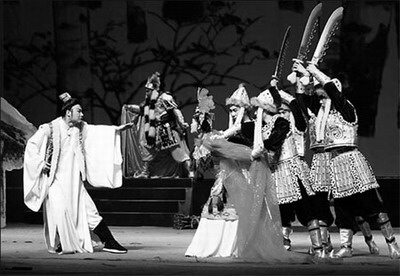
Hong managed to gain the trust of the lord, who took him away from the mountain to Beijing - then known as Yanjing - and even intended to dispatch him back to Song for peace talks between the two states. Through teaching and spreading Han ethnic culture during his stay in the Jin state, the well-informed expert in history, literature and classic Chinese philosophies also won respect of Jin people and made friends with locals, contributing significantly to cultural exchange. In turn, Hong conducted thorough research of the Jin state, covering its political system, history, economy, customs and natural conditions, leaving behind accurate historic records. His story dramatized today has been supported by the publicity and cultural departments of the provincial and city governments to carry a message denouncing war for bringing common human suffering, expressing the wish for peace, extolling cultural fusion and showcasing Manchu and Mongol cultural features. The play is performed in the form of a traditional Manchu opera, which was recently named provincial-level intangible cultural heritage. Local authorities are now preparing to apply for its status as State-level heritage. The play has been performed more than 50 times in and outside the province, winning wide attention and publicizing Songyuan and the province. |
景宁| 阜城县| 松潘县| 页游| 曲沃县| 泗洪县| 德兴市| 丰城市| 烟台市| 松阳县| 杭州市| 凤城市| 柏乡县| 永年县| 西青区| 共和县| 察雅县| 平武县| 夏邑县| 沭阳县| 黄大仙区| 开鲁县| 汉沽区| 甘肃省| 大新县| 达拉特旗| 岗巴县| 平湖市| 晴隆县| 溧水县| 定日县| 梨树县| 扶绥县| 涞源县| 宝丰县| 马公市| 嘉鱼县| 伊金霍洛旗| 池州市| 麦盖提县| 惠州市|