CHINA> Regional

|
CHINA> Regional
|
|
Millennia-old melodies to survive modern times
By Cui Jia (chinadaily.com.cn)
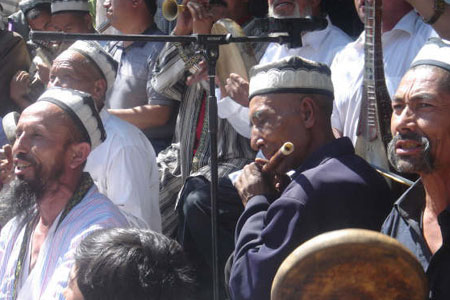
Updated: 2009-06-18 16:58 It is a set of melodies that stretches back 1,500 years, flowing out of the rich culture of the Xinjiang Uygur autonomous region.
But the Uygur Muqam art form and its traditional instruments are now being pushed to extinction by urban Uygur teens who are more interested in pop music and electronic guitars.
"It's a pity for us to see Uygur instruments such as the Satar and Tanbar being replaced by electronic instruments," he said. The Muqam is a musical mode and set of melodic formulas used to guide improvisation and composition. The system developed over the millennia and has also led to many musical genres among the people of Eurasia and North Africa. The United Nations Educational, Scientific and Cultural Organization also designated Xinjiang's Uygur Muqam as part of an Intangible Cultural Heritage in 2005. "Muqam to me is not just an art, it's my life," said 60-year-old Tusanes, who plays the Satar stringed instrument in his Muqam band. "Most of the artists in my band are over 60, I would like to see more youngsters joining us." The government is now introducing five measures to help keep the ancient Uygur music and its accompanying songs and ballads alive, so that Uygur cultural tradition and customs can be absorbed, adapted, documented and refined into various contemporary productions to be enjoyed by all ethnic groups. The measures include documenting the lyrics and melodies, providing professional training, setting up educational centers, sponsoring artists and raising awareness of the effort through the media. "We hope people, especially youngsters, can understand and accept the Uygur Muqam … to protect, inherit and promote this ethnic treasure," said Li Jilian, secretary and deputy director of the Xinjiang Art Research Institute. |
新密市| 凉山| 房山区| 行唐县| 马公市| 高陵县| 纳雍县| 夏邑县| 敖汉旗| 拉孜县| 确山县| 保定市| 黔西县| 牡丹江市| 泊头市| 白银市| 团风县| 图片| 凭祥市| 辽宁省| 武宣县| 忻州市| 武胜县| 德惠市| 安化县| 曲周县| 政和县| 澄江县| 巴林右旗| 湄潭县| 多伦县| 宜阳县| 红河县| 曲阳县| 柘荣县| 资阳市| 台东县| 阳泉市| 松溪县| 长垣县| 新津县|