CHINA> Focus

|
CHINA> Focus
|
|
Related
Chinglish: War of words
(China Daily)
Updated: 2009-06-17 09:06
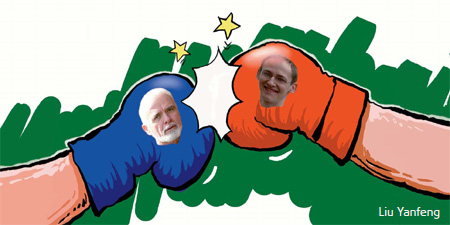 Is Chinglish linguistic trash or a cultural treasure? Two academics are going toe to toe over the issue: For American David Tool, it shows nothing but shameful disrespect for English, while German sinologist Oliver Radtke reckons it's an enlightening cultural gem.
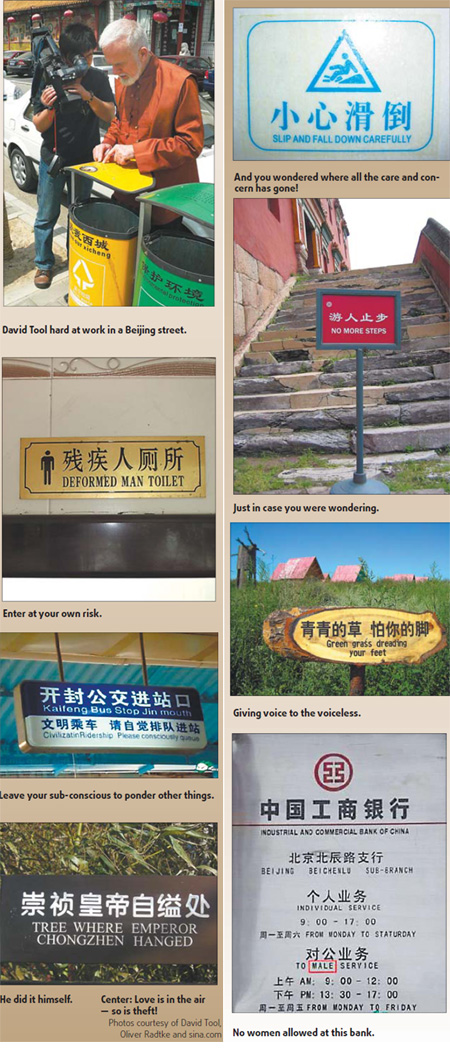 "Chinglish should be regarded with pride," says Radtke, who has collected more than 5,000 specimens on his website www.chinglish.de and published two books on the subject. "It's enriching an already-existing language, offering a new point of view, a new set of vocabulary and new usages." Radtke, who recently applied for what he says is the world's first PhD on the topic of Chinglish, believes the only exception is when mistranslations cause danger, exceptional inconvenience or include the F-word - a common software mistranslation of the character for gan, which also means "dry" or "do". "If you look at a lot of the Chinese signage examples with those translations, you can see how the Chinese mind is working; it's a window into how Chinese people think," Radtke says. "My goal is to let Chinglish be considered a bridge between two linguistic and cultural systems." But while Radtke contends Chinglish adds spice to the alphabet soup that is global English, Tool believes it often adds flies.
Rather than a point of pride, the Beijing Speaks Foreign Languages (BSFL) committee member argues most muddled translations are shameful. Since 2001, he has helped the Beijing government fix baffling Chinese-English signs and estimates he has so far edited more than 1 million muddled passages. He has become something of a local luminary for his work, garnering several top accolades, including a spot as the Olympic torch relay's second torchbearer. Tool says he supports use of some Chinese-English phrases that are at least as clear, and more concise, than "standard English", such as "no nearing", meaning "stay back". But he believes the cultural treasure idea is "basically nonsense". Chinglish, he insists, too often detracts from foreigners' understanding and appreciation of Chinese culture.
Radtke says Chinglish often works the other way, grabbing foreigners' attention. "How often do you remember the content of a museum a day after you left it?" he says. "The whole pedagogical approach is usually pretty dull ... so isn't it great to remember something from that day?" Radtke adds the Chinese-language information alone is usually vague and rarely contributes more than the Chinglish to visitors' understanding. He cites the example of a sign for "The former address of the emperor's toilet" at the imperial summer palace in Chengde, Hebei province. The sign's Chinese, he says, is nondescript but visitors are perhaps likelier to remember the spot because of the striking English wording. |
萝北县| 文化| 长阳| 临漳县| 杂多县| 尼玛县| 韶山市| 新建县| 无极县| 晴隆县| 遂昌县| 连南| 江津市| 闽清县| 海原县| 林州市| 瓦房店市| 枣强县| 毕节市| 东宁县| 萨迦县| 灯塔市| 阳春市| 新营市| 平原县| 吴堡县| 鹤岗市| 湘潭市| 海晏县| 富阳市| 桂阳县| 南华县| 宁夏| 固原市| 洮南市| 纳雍县| 桃园市| 凌源市| 商河县| 长寿区| 皋兰县|