CHINA> National

|
CHINA> National
|
|
3rd excavation to begin at terracotta army site
(China Daily)
Updated: 2009-06-10 08:27 Archaeologists will begin a third phase of excavation at the famous terracotta army site on Saturday, hoping to find more clay figures and unravel some of the mysteries left behind by the "First Emperor". 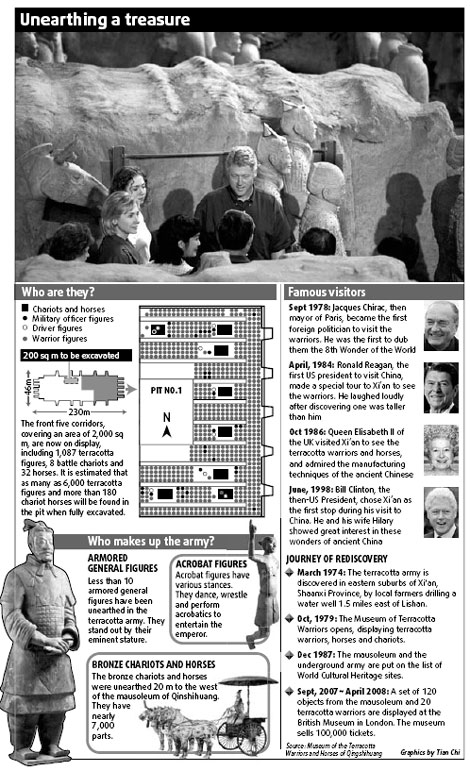 The excavation work will focus on a 200-sq m patch in the north-central part of the No 1 pit, the largest among three pits at the site. Archaeologists hoped to find more clay figures of high-ranking officers, Liu Zhancheng, head of the archeological team under the terracotta museum in Xi'an, capital of Shaanxi province, was quoted by Xinhua News Agency as saying yesterday. Such high-ranking army officers are rare. The majority of the terracotta are archers, infantrymen and charioteers that the emperor hoped would help him rule in the afterlife. The museum website said less than 10 such "armored generals" have been unearthed. Liu also said the excavation will test preservation technology that the museum has spent decades developing to keep the undiscovered terracotta figures intact and retain their original colors. In past excavations, richly colored clay figures were unearthed from the mausoleum of Qinshihuang (259-210BC), the first emperor of a united China, but once they were exposed to the air they began to lose their luster and turned an oxidized grey.
But he also noted that people should not put too much hope on seeing vividly colored terracotta from the upcoming excavation because "the No 1 pit was the most severely damaged among the three pits by a large fire". The cause of the fire, which began long before excavations took place, remains a mystery, he said. Museum sources, however, declined to reveal the reason why they planned to excavate the 200-sq m patch, which is not linked to the already unearthed part. The State Administration of Cultural Heritage has approved the museum's plan for the third excavation, and the excavation is likely to continue if it proves fruitful. Wu Yongqi, curator of the museum, said that the 230-m by 62-m pit is believed to contain about 6,000 life-sized terracotta figures, more than 1,000 of which have been found in previous excavations. The upcoming excavation will last at least a year, he said. The army of terracotta warriors and horses was one of the greatest archeological finds of modern times. It was discovered in Lintong county, 35 km east of Xi'an, in 1974 by peasants digging a well. The first formal excavation of the site lasted from 1978 to 1984 and uncovered 1,087 clay figures. A second excavation, in 1985, lasted a year and was cut short for technical reasons. The discovery, listed as a World Heritage Site by UNESCO in December 1987, has turned Xi'an into one of China's major tourist attractions. Many state leaders have traveled to the site during visits to China. China Daily |
|||||
康平县| 临西县| 黑河市| 乌拉特前旗| 灵台县| 洛扎县| 灵川县| 安溪县| 绥棱县| 峨山| 合作市| 泸溪县| 泉州市| 台北市| 独山县| 嘉善县| 和龙市| 积石山| 监利县| 扎兰屯市| 潞西市| 新沂市| 靖边县| 砀山县| 水富县| 闽清县| 巴南区| 开鲁县| 赤壁市| 格尔木市| 南昌县| 当雄县| 黄骅市| 阜阳市| 桂阳县| 聂拉木县| 平和县| 安化县| 宁强县| 屏东市| 沁源县|



