CHINA> National

|
CHINA> National
|
|
Related
China's finest telescope to trace universe's origin
(Xinhua)
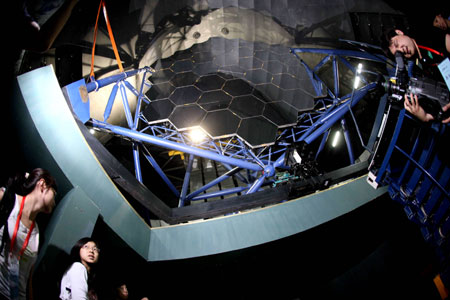
Updated: 2009-06-05 11:20 Inspired by her mentor Su Dingqiang, a leading Chinese astronomer who is also a prestigious CAS member, the 58-year-old Cui combined a 15-story-high scope with a missile silo-like observatory tower on top of a 960-meter hill 170 kilometers northeast of Beijing. During observation nights, the upper parts of the lower dome are removed and starlight is reflected from the mirror up through the 40-meter tube to the primary mirror. The light of space is fed into the front ends of optical fibers positioned on a focal plane, before real-time data are recorded into spectrographs fixed in a room underneath. The idea was developed from the spherical and aspherical mirror combination, invented by German opticist B. V. Schmidt in 1931. It also uses advanced active optics technologies.
Dr. R. N. Wilson, inventor of the active optics theory, wrote in an e-mail to Cui, his former colleague at the European Southern Observatory, that LAMOST "embodies every aspect of the most advanced and modern telescope technology." Carrying on mankind's dream of understanding the universe, inspired by the invention of astronomical telescope by Italy's Galileo Galilei, Chinese scientists are hoping to capitalize on the "costly big toy" to unravel dark matter, dark energy, as well as celestial formation and evolution. Before LAMOST, the American Sloan Digital Sky Survey (SDSS) had been the most powerful spectra-collecting optical telescope. Installed in a New Mexican astronomical station, SDSS has an aperture of 2.5 meters.
"We're quite comfortable with the scans," Cui said. "Most of the time, we shot the targets exactly, if not hitting the bull's eyes." University of Chicago Prof. Donald York, founding director of SDSS, said in an e-mail interview with Xinhua that the data for well-positioned fibers of LAMOST looked "very good." York, however, said that precise calibrated data in wavelength and absolute flux of the celestial bodies cannot be done until the telescope's fiber positioning becomes "perfect" after debugging. California Institute of Technology astronomer Richard Ellis said, "A large telescope is one of the best examples of what a civilization does well, and I think here we look at the LAMOST now and we see what China has done." Cui said Chinese scientists might consider building a similar big telescope on Antarctica, to gain wider and clearer cosmic view. |
浙江省| 鹿泉市| 长泰县| 江永县| 永胜县| 黔东| 望都县| 松江区| 福鼎市| 鄄城县| 西峡县| 鄄城县| 黄浦区| 大城县| 孟村| 湟中县| 新津县| 炎陵县| 莱西市| 丹东市| 顺义区| 扶风县| 雷州市| 巴彦淖尔市| 浏阳市| 嵊州市| 鄯善县| 韶山市| 正镶白旗| 张北县| 清涧县| 北海市| 四平市| 富平县| 当阳市| 河津市| 独山县| 鹰潭市| 皮山县| 都昌县| 绿春县|