CHINA> National

|
CHINA> National
|
|
New holidays woo Chinese back to tradition
(Agencies)
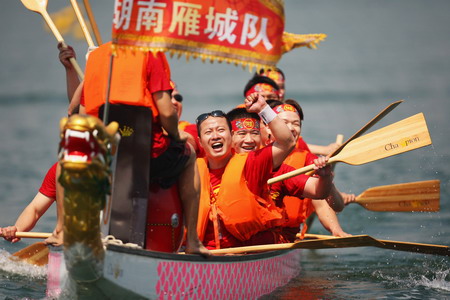
Updated: 2009-05-28 17:40 BEIJING -- Instead of toiling in an office cubicle as she did two years ago, Ma Yanyan is spending Thursday's Dragon Boat Festival as befits tradition: rowing in sync to a thundering drum beat with 20 teammates across a lake. The government's decision to elevate three traditional festivals to national holidays gives Chinese, especially city dwellers, a chance to return to their roots and marks an evolution in the country's leisure time.
Days off were once considered a frivolity -- the two-day weekend was introduced fewer than 15 years ago -- but have increasingly been added to the national calendar as the government embraced free-market reforms and tried to boost domestic spending. Keen on bolstering traditional culture, authorities revised the program again early last year, trimming one weeklong holiday and allocating the extra days for three, shorter customary holidays.
The holiday commemorates the poet and government minister Qu Yuan, who drowned himself to protest corruption in the royal court 2,000 years ago; the dragon boats are meant to scare off evil spirits from consuming his body. The shorter holidays -- which also mark the mid-autumn and tomb-sweeping festivals -- mean many Chinese are staying closer to home, and some observers say it has also spurred interest in Chinese culture. "Even though Chinese have always celebrated traditional holidays, it has become more and more meaningful due to the new law," according to Liu Kuili, director of the China Folklore Association and a professor at the Chinese Academy of Social Sciences, a top think tank. "Rather than just blowing money on a shopping spree, they have time to make an effort to light lanterns at a community street fair or learn to make traditional foods such as dumplings." The number of Chinese who visited cemeteries to honor ancestors during April's tomb-sweeping festival soared to 100 million last year, nearly double the number in 2007. The figure climbed to 120 million this year, Liu said quoting the Ministry of Civil Affairs statistics. The government also hopes the renewed attention on traditional Chinese events will diminish the enthusiasm of younger Chinese in embracing Western holidays such as Christmas and Valentine's Day, said Liu. But the new, shorter holidays have also drawn complaints from travel agencies and local governments that are looking to tourism to reduce the impact of the slack economy. They used to depend on the three weeklong holidays around the Lunar New Year in the winter, National Day in October and May Day, instituted nearly a decade ago. Worried about the slump, the southern province of Guangdong announced plans to reinstate the weeklong May Day holiday, but the central government revoked the decision. "There's no time to take a long vacation these days, and our business is down at least 60 percent from last year this time due to the new shorter holidays," said Wei Bo, an agent at Zhouli Sports Travel Agency in Beijing. Wei is the founder of the Beijing Fiat Car Club, which used to organize weeklong cross-country road trips for groups of more than 100 drivers, but no longer, he said, since few have the time. Li Feiyun, a 35-year-old executive with an international trading company in Shanghai, said her mother-in-law taught her to make zongzi, the traditional glutinous rice dumpling wrapped in bamboo leaves and eaten during the Dragon Boat Festival. But Li said she is the only one in her immediately family who knows how. "With many young people working longer hours now, there's a desire to create more meaningful memories with our time off," said Li, who works for an international trading company in Shanghai. |
||||||
潞城市| 理塘县| 神木县| 吉木萨尔县| 珠海市| 崇左市| 屏南县| 慈溪市| 香河县| 潼关县| 商河县| 南皮县| 马尔康县| 深圳市| 海伦市| 乌鲁木齐县| 曲麻莱县| 大悟县| 平陆县| 宜州市| 金华市| 陕西省| 建始县| 收藏| 象州县| 伊金霍洛旗| 庆城县| 连江县| 延长县| 盐城市| 安岳县| 左权县| 武陟县| 麻栗坡县| 新建县| 丽江市| 偏关县| 郯城县| 陇川县| 文安县| 福安市|