CHINA> Regional

|
CHINA> Regional
|
|
One man's pork is another man's pain
By Diao Ying and Shen Jingting (China Daily)
Updated: 2009-05-16 08:46 The past few weeks have been a boon for Liu Guoliang, a construction worker in Beijing, for he has been enjoying a pork dish every day.
 "I couldn't afford to buy pork earlier because it was too expensive," Lin said on Friday. Lin earns about 1,000 yuan ($147) a month, and finds "pork affordable now".
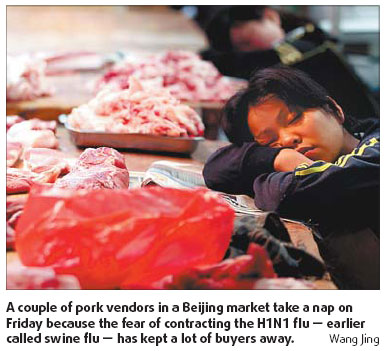
Prices of pork, the staple meat for most Chinese, has been falling for the past 16 weeks, according to Ministry of Agriculture figures. In some places prices have dropped to levels not seen in years. The national average pork price for the May 4-10 week was 13.68 yuan a kg, about 28 percent less than when the fall began. Ministry of Commerce spokesman Yao Jian said a key element of the bailout plan was expanding the country's cold storage chain so that more pork can be stored. The government's procurement plan, which would last several weeks, and the expansion of the cold storage expansion chain will provide farmers a chance to sell their "excess" products, industry insiders said. On May 12, the National Development and Reform Commission (NDRC), China's top economic planning body, said falling pork prices were a matter of concern. NDRC officials told China Daily that they were preparing a procurement plan that would enable the government to buy part of the surplus pork in the market. To draw buyers, pork retailers in many parts of the country are fighting a price war. The minimum price in Jilin province is already less than 10 yuan a kilogram. It was 11 yuan a kg three months ago. And supermarkets in Hubei province are selling it for 10.39 yuan a kg compared with the 14.3 yuan a kg in March. Some local governments have already started their procurement plan. The Sichuan provincial government, for instance, has introduced the scheme ahead of others because pork prices there are already below the national average, according to Tianfu Morning Post. Market analysts said the drastic fall in prices could be attributed first to soaring prices between 2007 and 2008, when natural disasters hampered supplies nationwide. Later new investments, some from even urban industrial and financial firms, resulted in mushrooming of pig farms. That led supply to surpass demand in a short time, said Wu Yan, a food analyst with Northeast Securities. And then the H1N1 flu (earlier called swine flu) scare dealt another blow to pork sales. Chen Dirong, a Beijing pork vendor, complained that sales had not picked up even after a big drop in prices. "Not many people are buying pork after the H1N1 scare." He used to sell about 50 kg of pork a day, but now manages to get buyers for only 15 kg, he said. Some officials said pork prices have fallen because of the "seasonal factor", too, because people tend to eat less meat in the summer. But now prices have almost reached the bottom, Wu said, and would pick up in August, when there is likely to be better balance between demand and supply. In the intervening period, the government should take some action to help stabilize the market, he said. Since pork prices tend to fluctuate wildly every two to three years, some sort of "intervention is necessary". |
洞头县| 黄平县| 兴义市| 澄城县| 大英县| 建始县| 东港市| 横山县| 龙口市| 南皮县| 云南省| 云和县| 广南县| 绥棱县| 易门县| 丰县| 阿拉尔市| 咸宁市| 芮城县| 黄梅县| 尚义县| 临邑县| 白河县| 扎赉特旗| 青川县| 藁城市| 枣阳市| 布尔津县| 玉山县| 通海县| 馆陶县| 怀远县| 湖南省| 丽江市| 文化| 莲花县| 凌云县| 泾川县| 邢台县| 宿迁市| 青岛市|



