CHINA> Focus

|
CHINA> Focus
|
|
A long and winding road to recovery
By Lan Tian, Song Jing and Liang Qiwen (China Daily)
Updated: 2009-04-28 11:00 The State Council has promised authorities at all levels will allocate 850 billion yuan for the plan over the next three years, which includes 331.8 billion yuan from the central government. "The government should shoulder more responsibility in terms of funding for medical and health fields," said Yu Guangyan, director of Peking University Dental Hospital, during this year's session of the National Committee of the Chinese People's Political Consultative Conference in Beijing. But he doubted funding would be available from local authorities.
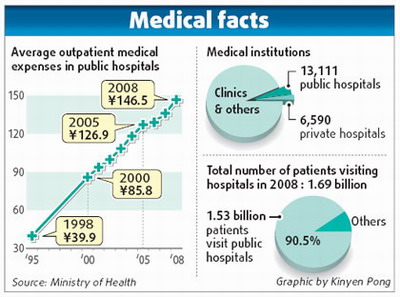 Gu Xin, a researcher for the China Society of Economic Reform, is also worried. He said: "Public welfare means patients can pay a low price for medicine and health services, but it means the government must increase its current funding eightfold. I don't think it has enough money to do it." He said the health system would collapse if public hospitals lowered prices for patients but failed to receive the extra funding. However, Vice-minister of Finance Wang Jun assured: "I believe the funding will be made in time and in full because we have given full consideration to the financial capacity of local governments when drafting the plan." He said 280 billion yuan would go to hospitals and health facilities, while the rest will be used mainly to improve the medical insurance system.
The medical reform plan will see local health bureaus urged to stop operating public hospitals, define the responsibilities and rights of hospital proprietors and administrators, probe the corporate governance structure and refine personnel systems by introducing performance-related pay. The move was welcomed by Zhu Hengpeng, a researcher for the institute of economics at the Chinese Academy of Social Sciences, who said: "Governments should not be administrators and managers at the same time. If they continue acting as owners of the public hospitals and referees of medical markets, there will be no fairness." Chi of the CIRD agreed. He said the government must evaluate its relationship with public hospitals or "face many difficulties", while it was vital to give hospitals and doctors "incentives". In China, 10 percent of hospitals are privately-run enterprises, official statistics show. They have welcomed the reform road map as it will give them equal rights with public facilities when it comes to access requirements, medical insurance policy and scientific research policy. "It gives our hospital the opportunity to develop, attract more professionals and upgrade our technology," said Ho Gwo-Hao, special assistant to president of Xiamen Chang Gung Hospital. "With equal status, private and public hospitals would offer better services for patients and make progress together through healthy competition." Established last year, the Xiamen unit is the biggest private hospital in China but limited regulations have forced it to run as a profit-making enterprise, contrary to its non-profit orientation, and does not currently enjoy preferential treatment on sales tax and electric power charges. Despite the many challenges ahead, there is a promising future for China's public hospital reform, agree officials and experts. "Medical reform is a worldwide problem. We should take a positive attitude towards the problems and persistently seek solutions," said Zhang Mao, the Party chief at the MOH. Ling Feng, a chief neurosurgeon at Xuanwu Hospital under the Capital Medical University in Beijing, agreed. "The public hospitals reform will be achieved eventually. But we cannot reach the aim in one move," he said. After confiscating their dialysis machines, Tongzhou health bureau has offered all 10 of the uremia sufferers in Baimiao temporary, free kidney dialysis in local hospitals while their home provincial or autonomous regional governments work to solve their problems. But Wei Qiang still dreams of a long-term solution. "We are doomed to die, we are as small as ants," he said. "But we still want to live. I hope the government will help us survive."
|
邵东县| 平顶山市| 凤山市| 延寿县| 海林市| 阿荣旗| 中阳县| 丰原市| 洛扎县| 社旗县| 德清县| 满城县| 开阳县| 汝南县| 饶阳县| 鲁甸县| 武夷山市| 南和县| 正安县| 大田县| 明星| 渝北区| 临海市| 勐海县| 凌源市| 仪陇县| 广宗县| 阳江市| 永清县| 巩义市| 盐津县| 安泽县| 宣恩县| 丰宁| 杨浦区| 加查县| 安国市| 龙岩市| 宜宾市| 台南市| 侯马市|



