CHINA> National

|
CHINA> National
|
|
Grain output poised for huge boost
By Hu Yinan (China Daily)
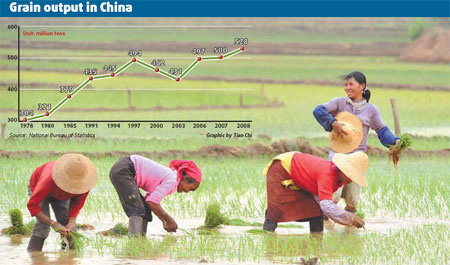
Updated: 2009-04-09 09:46 China plans to boost its annual grain output capacity to more than 550 million tons by 2020, an increase of 50 million tons from 2007. The State Council approved the plan at a meeting presided over by Premier Wen Jiabao Wednesday.
"Grain security has always been the top priority in maintaining development and stability. It is also an important foundation to boosting domestic demand to cope with the global financial crisis," the plan said. The country had its fifth consecutive summer harvest in 2008, with grain output rising 5.4 percent year-on-year to a record high of 528.5 million tons. Last Wednesday, it started a three-month nationwide survey of its grain stores.
Yuan said the government could raise the minimum purchasing-price of grains by about 22 percent - much higher than this year's 13-percent target, the Guangzhou Daily reported Wednesday. "This way, farmers will earn more as their crop production increases it will get farmers plowing the fields again," the 79-year-old said. Yuan's suggestion translates into an additional 20 billion yuan ($2.9 billion) in State subsidies, which he says the central government "is fully capable of" earmarking. After years of agricultural-friendly policies, Chinese farmers, still numbering more than twice the population of North America, receive 100 yuan ($15) in government subsidies for every mu (1/15 of a hectare) of crops they grow. But that is about all they get, because the average rural Chinese owns 1.38 mu (0.09 hectares) of arable land. Most rural labor had left for the cities during China's rapid urbanization, while those left behind find little incentive to grow crops when short-term jobs in counties and towns promise much higher, and more stable, pay. Some farmers were unwilling to irrigate their fields - an act they considered "uneconomical" compared to exploring urban job options - during the recent drought that parched northern China, the worst in 50 years. And with fewer people engaged in farming, Yuan, who has been credited with feeding millions of Chinese with the hybrid rice he developed in the early 1970s, views raising the annual per-mu output as the only viable way to secure China's dwindling arable land supply. Through hybridization, Yuan achieved an average annual output of more than 800 kg of rice per mu - more than double that of ordinary rice. He hoped to reach an output of 900 kg per mu by 2012. The agriculturalist will submit a relevant proposal to Wen, who is expected to meet him at his hybridizing research base in Hainan province's Sanya city some time around the Bo'ao Forum for Asia later this month. Xinhua contributed to the story |
||||||
手机| 石景山区| 铜陵市| 诸城市| 沂南县| 葫芦岛市| 宝清县| 安康市| 连平县| 海盐县| 阜城县| 巴塘县| 启东市| 榆中县| 贵溪市| 台中市| 湘乡市| 白沙| 仙桃市| 汉沽区| 民县| 阜康市| 张家港市| 临夏市| 泗阳县| 内江市| 阿城市| 桂阳县| 泽普县| 双辽市| 公安县| 丽江市| 赤峰市| 玉山县| 綦江县| 屏东县| 双辽市| 商河县| 江陵县| 钟山县| 沾益县|