CHINA> National

|
CHINA> National
|
|
Official raps Dalai clique's insincerity
(Xinhua)
Updated: 2009-03-26 15:38 BEIJING -- A Chinese central government official has criticized the Dalai Lama and his followers on Thursday for being "stubborn in talks" and "failing to honor their promises".
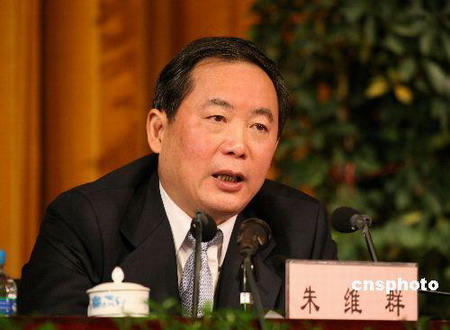
Zhu Weiqun, vice minister of the United Front Work Department (UFWD) of the Communist Party of China (CPC) Central Committee, expounded on his stance in an interview carried Thursday in the overseas edition of the People's Daily, the CPC's flagship newspaper.
When asked to describe the attitude of the Dalai Lama and his supporters in the talks, Zhu said they were "very difficult to talk with and very stubborn." Nine rounds of talks have been held between Chinese central government officials and the Dalai Lama's private envoys since 2002, three of which were in last year. "The last round of talks was actually stuck in a very difficult position. Many asked me if that meant a breakdown," he said, referring to a discussion Oct. 31 to Nov. 5, when the Dalai Lama's private representatives, Lodi Gyari and Kelsang Gyaltsen, were in China. "I didn't worry about it too much, for it has been like that in each and every of the last nine talks," he said. The Shenzhen talks on May 4 last year were the first between the two sides after the March 14 Lhasa riot. During the talks, Zhutold the Dalai Lama envoys to stop divisive activities, stop violence and stop sabotaging the Beijing Olympic Games. The Dalai Lama's envoys, on the other hand, denied their part in the Lhasa riot. In the July discussions, the Dalai Lama's representatives said they had no problems following the "four not-to-supports" put forward by the central authorities. The four promises included: not supporting activities that would disturb the Beijing Olympic Games; not supporting plots inciting violent criminal activities; not supporting and concretely curbing violent terrorist activities of the pro-secession "Tibetan Youth Congress"; not supporting any argument and activity seeking "Tibetan independence" and splitting the region from the country. "But what did they do then? They absolutely forgot to carry out their promise and did not stop boycotting and destroying the Beijing Olympics," Zhu said. "Instead, they intensified sabotaging activities and continued to attack the central government." "They supported the 'Tibetan Youth Congress' and other organizations to publicly advocate 'Tibetan independence' and fanned or organized violent criminal activities," Zhu said. "They also continued to set up a claim to internationalize the Tibet issue, trying to make use of foreigners to press the central government." "They continued to collude with such dregs as overseas democracy activists, 'Falungong elements' and 'Eastern Turkistan terrorists,' trying to form so-called 'united front work' to oppose the central government and split the motherland," he said. "All of these have caused the Chinese people strong aversion to their actions." As early as the 1980s, high ranking officials from the central authorities had told a delegation to the Dalai Lama it was impossible to change Tibet into a country, to carry out a "high degree of autonomy" or to create a larger Tibet autonomous region. "However, more than two decades have passed, they still use this trick to talk in a roundabout way with central authorities," Zhu said. "That showed they lacked sincerity." "For the contacts and talks' failing to make progress, they should bear full responsibility," he said. The Dalai Lama has been assuming an image of non-violence on many international occasions. With the placard of "non-violence" in hand, he on the other hand turned a blind eye to violent activities, the official said. "Many people died in the March 14 Lhasa riot, and he called it a peaceful protest and said he wouldn't ask Tibetans to stop. Was it the so-called non-violence and wasn't he inciting violence? " Zhu questioned. The official said the central government had shown tolerance and patience toward the Dalai Lama over the years of contacts and talks. In 1959, the Dalai Lama fled abroad after a failed armed rebellion, and then declared he would seek Tibet independence. At the beginning of the 1960s, he and his followers, with foreign support and armed with foreign weapons, harassed the Chinese border for 10 years. He then said he wanted to stop "Tibet independence" at the beginning of the 1980s, and the central government immediately contacted with him and invited those close to him back to China for talks and visits for 20 times, Zhu said. However, he wrongly assessed the situation at the beginning of the 1990s and declared he wouldn't talk with "a regime that would soon collapse," and stopped contact with the central government in 1993. Their expectations failed to deliver and they then proposed for contacts again. So starting 2002, the central government began to talk with them again, Zhu said. "The process shows that the central government has been lenient and expected the Dalai Lama to choose the right path," Zhu said, "our door remains open as always." |
嘉禾县| 古交市| 通河县| 屏南县| 平和县| 包头市| 酒泉市| 株洲县| 乌兰察布市| 宁海县| 佛坪县| 沅江市| 大同县| 南充市| 扶余县| 昭苏县| 龙海市| 新和县| 鱼台县| 道真| 凌云县| 阿拉善盟| 梧州市| 津南区| 汕头市| 大埔区| 扬中市| 水城县| 军事| 曲阜市| 墨玉县| 丽水市| 云龙县| 太谷县| 武宁县| 普定县| 九龙城区| 南陵县| 益阳市| 定边县| 竹北市|