CHINA> Regional

|
CHINA> Regional
|
|
Panchen Lama calls for support for CPC leadership
(Xinhua)
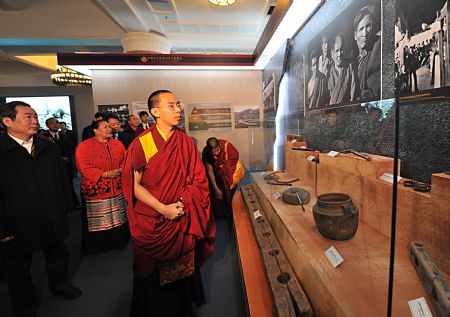
Updated: 2009-03-22 16:58 BEIJING -- The 11th Panchen Lama Gyaincain Norbu has called on people in Tibet to support the leadership of the Communist Party of China (CPC), to which he credited the highland region's prosperity and development today. In a signed article to be carried by Monday's People's Daily, the Panchen Lama, one of Tibet's most senior living Buddhas, said the hard-earned happy life of today's Tibetans should be greatly cherished.
Only the CPC could enable serfs in Old Tibet to enjoy dignity as human beings and freedom, he said in the article. "As facts showed Tibet could only achieve today's prosperity and development as well as a more beautiful future under the CPC leadership," he said. He cited a line of Buddhist scripture about the significance of good leaders and patriotic people to a country.
"All monks and nuns should uphold patriotism, abide by the law and commandments, and carefully study the essence of Buddhism," he said. The Panchen Lama promised that he would inherit his predecessor's tradition to be a patriot and uphold the "four great loves" as set fourth by the 10th Panchen Lama: the love of the CPC, of socialism, of his own ethnic group and of religious belief. He would continue to guide Tibetan Buddhists to adapt to the country's socialist society and strive to contribute to the nation's unification, ethnic unity and people's happy life. In 1951, the Central People's Government and the Local Government of Tibet signed an agreement on the Measures for the Peaceful Liberation of Tibet, or the 17-Article Agreement. It signified the peaceful liberation of Tibet and enabled the region to shake off the trammels imposed by imperialist aggressors, he said. In 1959, the central government and Tibetan people halted an armed rebellion, and the Chinese government launched democratic reform to end the feudal serfdom system and liberate serfs, he said. Tibetan legislators endorsed a motion in January this year designating March 28 as Serfs Emancipation Day, to commemorate the emancipation of millions of serfs and slaves in Tibet 50 years ago. "As a descendant of serfs in Old Tibet and the successor to the Panchen Lama Erdeni, I'm very excited as the whole country is celebrating the first Serfs Emancipation Day," the 19-year-old Panchen Lama said. The central government has established a series of preferential policies to promote economic and social development in Tibet since it adopted the reform and opening up policy three decades ago, he said. Since then, the central government has been investing in projects, giving subsidies and calling on people across the country to offer aid to Tibet, the Panchen Lama said. The measures greatly facilitated economic and social development in the region. Huge progress was also made in the past five decades in enabling the Tibet Autonomous Region to practice self-government in its region, the protection of traditional Tibetan culture and heritage, and the promotion of freedom in religious belief, he said. Gyaincain Norbu, born on Feb, 13, 1990 in Lhari county of Nagqu prefecture in northern Tibet, was approved by the central government in November 1995 as the reincarnation of the 10th Panchen Lama, who died in 1989, after a lot drawing ceremony among three candidates in the Jokhang Temple in Lhasa. He was enthroned as the 11th Panchen Lama on December 8, 1995. Drawing lots from a gold urn to decide on the final choice of the reincarnation of a high lama is a tradition in Tibetan Buddhism. Gaining the approval from the central government on the choice is a practice that began in the Qing Dynasty (1644-1911). |
台东县| 柳州市| 温宿县| 女性| 延吉市| 松溪县| 将乐县| 大安市| 法库县| 丰台区| 图木舒克市| 阿鲁科尔沁旗| 林口县| 秦皇岛市| 呼和浩特市| 太仓市| 介休市| 西昌市| 安远县| 镇宁| 贡嘎县| 临邑县| 大同县| 黑水县| 罗源县| 庆阳市| 浦城县| 体育| 尉氏县| 天津市| 阳东县| 安达市| 绵阳市| 闻喜县| 新兴县| 维西| 开封市| 延安市| 克山县| 大竹县| 永年县|