CHINA> Regional

|
CHINA> Regional
|
|
China's Gobi desert source of rare dinosaur find
(Agencies)
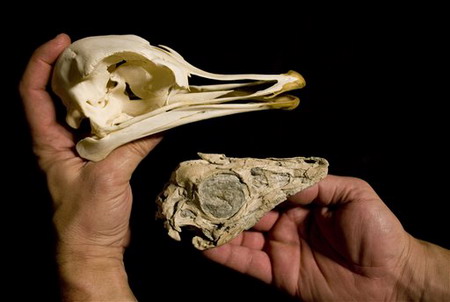
Updated: 2009-03-17 11:21 BEIJING -- Left on their own by adults, the young dinosaurs sank into the mud beside a lake and died 90 million years ago in what would become the Gobi Desert. The well-preserved fossils, excavated by a team of Chinese and American scientists, offer a rare bounty of clues about how this herd of ostrich-like sinornithomimus lived - and died.
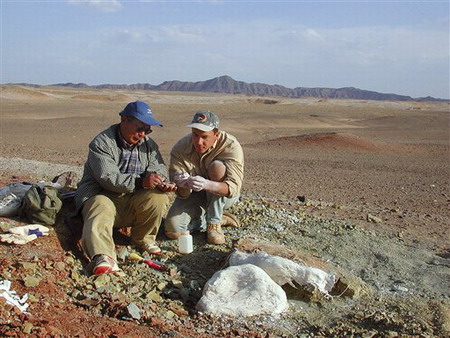
Two life-sized models of the sinornithomimus were put on public display for the first time Monday in Hohhot, capital of north China's Inner Mongolia autonomous region. "This is a very exciting discovery, because 99.9 percent of the time, we find a group of skeletons that died at different periods due to unknown causes," said Paul Sereno, a University of Chicago professor on the excavation team. "The other 0.1 percent of the time, scientists consider themselves lucky to find small herds that have been well-preserved after floods or volcanic eruptions, similar to that of Pompeii." Italy's famous city of Pompeii was buried - its way of life frozen in time-- in the volcanic eruption of Mount Vesuvius in AD 79. Sereno, a paleontologist, helped lead the 2001 expedition that uncovered the fossilized remains of the 25 young sinornithomimus near Suhongtu, a tiny, remote village in the Gobi desert about 370 miles (600 kilometers) west of Hohhot.
The position of the dinosaur bones suggests they were looking for water on the edge of a lake, got stuck and died as the mud engulfed them, Sereno said in a telephone interview. Their hip bones were found at odd angles, indicating scavengers tugged at their carcasses. Crablike organisms were also found surrounding the skeletons, a clue that tells scientists they were covered in water shortly after death, which helped preserve them. Tan Xinwei, a paleontologist from the Inner Mongolia Department of Land and Resources who also worked on the expedition, said the findings tell researchers that "the youngsters were left to fend for themselves while the adults were preoccupied" with hatching eggs or building nests. The two-legged, feathered dinosaurs reached about 4 feet (1.2 meters) tall as adults and scavenged for small plants by jutting out their long necks in an ostrich-like fashion, Sereno said. |
民勤县| 略阳县| 错那县| 都兰县| 马尔康县| 北海市| 淄博市| 富裕县| 元江| 蒙自县| 卢氏县| 三河市| 綦江县| 武夷山市| 花莲市| 双峰县| 正定县| 琼海市| 乐亭县| 云梦县| 新和县| 东阳市| 道孚县| 顺平县| 咸丰县| 合作市| 邳州市| 廉江市| 霍城县| 二连浩特市| 喀什市| 姜堰市| 广宁县| 鄯善县| 奈曼旗| 隆回县| 武定县| 乌鲁木齐县| 灯塔市| 霍邱县| 临清市|