|
|
Minority groups with major concerns
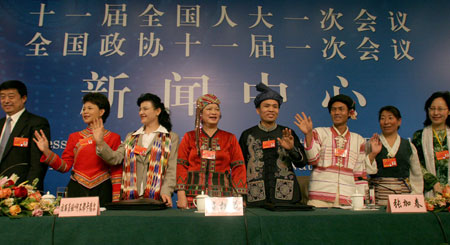
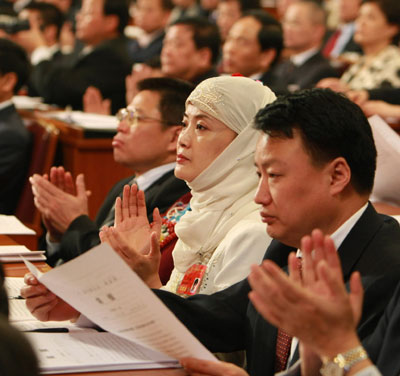
(China Daily) Updated: 2008-03-11 08:21 Much attention is paid to the unique attire of minority NPC deputies but concern over the social, economic and cultural development of their regions is also deservedly high, Wu Haiying, a deputy of the Hui ethnic group, said yesterday.
Wu was speaking to Chinese and foreign journalists together with seven other deputies of ethnic minority groups. "As a primary school teacher in the countryside, I know deeply the importance of education for minority people," Baobulu, a deputy of the Jino ethnic group from Jinghong, Yunnan province, said. With a little more than 20,000 people, Jino has one of the smallest populations among the country's 56 ethnic groups. The average annual income of Jino members is less than 2,000 yuan ($280). Baobulu showed reporters a painting by one of his students, which included houses, a board with the school's name and new roads. He said the artwork conveyed the student's longing for a better study environment. "Only with the development of education can we have better lives. We hope to get support and help to improve our educational situation," he said. Gesang Zhuoga, a Tibetan deputy who is the Party secretary of Tarmar village in the Ngaqen township of Lhasa, said that the opening of the Qinghai-Tibet railway helps Tibetan people not only in terms of its economy, but also education. "For Tibetan students who go to study in other parts of China, taking a train on the Qinghai-Tibet railway is not only convenient, but also cheap," she said. Zulifeiya Abudukader, a deputy of the Uygur ethnic group, said that great attention has been paid to education in Xinjiang, and both Han and minority languages are used and studied in all schools in the autonomous region. "The customs of minority people have also been respected. For example, under the Marriage Law, the minimum age for marriage for the Han is 22 for men and 20 for women, while for minorities in Xinjiang it is 20 for men and 18 for women," she said. Zulifeiya also cited a special family planning policy in Xinjiang. "In Xinjiang, minority people can have two children, such as I have. In southern Xinjiang, people can have three children. If all three children are girls, the family can have a fourth child," she said. Zhang Jiachun, a deputy of the Shui ethnic group, used the interview opportunity to promote his people's culture. He displayed two items that have been listed as part of the national intangible cultural heritage: His maweixiu clothes, woven with the hair of horsetails; and a calligraphy work written in the traditional Shui ideograph that reads "let the world know the Shui people". |
|