CHINA> Focus

|
CHINA> Focus
|
|
More foreigners crazy about Chinese medicine
By Xie Fang (China Daily)
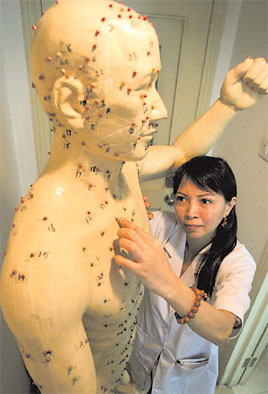
Updated: 2008-12-16 10:56 Bai currently has 11 interns and when she arrives at 8 in the morning, a crowd of patients is already waiting for her. Her two consulting rooms can accommodate up to 20 people. Surrounded by a group of interns, Bai takes measurements of a patient's skull to find the right acupuncture points. Before inserting needles in his or her head, she asks her students to touch the points and instructs them how to use the needle correctly in terms of pressure, angle and depth. Bai often uses the Socratic method in teaching - she tests her students by asking them to explain what effect inserting a needle into a particular acupuncture point will have. If the answer is correct, the teacher's face lights up with a smile. "Well done!" she says.
Ryu Eun Sang, 36, is the most experienced of Bai's foreign interns. After obtaining a PhD in acupuncture, he opened a clinic in Seoul, South Korea, but closed it in 2006 to come to Beijing. He became Bai's student in March. "I never expected to stay in China for so long," Ryu says. "If I just wanted to learn some treatment methods, I could have returned to my country much earlier. What I really wanted to learn from Dr Bai is her drive to continue to expand her knowledge, no matter what age." Despite her full schedule at the hospital, Bai makes time to do research as well as study English. "She is capable of curing many difficult and complicated cases, but unlike other doctors of her age, she is not satisfied and keeps learning. That is what I like the most about her," Ryu says. Byong Hoon Lee, 30, an Australian of Korean descent, became one of Bai's students two months ago. Lee's pockets are always stuffed; he carries an acupuncture textbook in English in one pocket and a small notebook in another. "Dr Bai has found some acupuncture points that are not mentioned in my textbook, so I write them down for further study, which is very helpful," Lee says. For all the foreign interns, the most difficult part of studying acupuncture is the Chinese language. "Even though I have no problem communicating in Chinese, I don't always catch every word when taking notes," says Ling. "The underlying principles of TCM are also too deep and complicated for me to understand." Coba Carrion, meanwhile, is not sure Ecuadorians will accept acupuncture. "It will require a lot of explanation but I am confident of its powers," he says. Ryu is about to return home and open a new TCM clinic in Seoul but adds: "What I really want is to have a Chinese acupuncture license to work as a doctor in Beijing." So far, no foreigner has been licensed as an acupuncturist in China.
|
湖南省| 布尔津县| 鄂尔多斯市| 长葛市| 陆河县| 竹溪县| 建瓯市| 神池县| 华池县| 孝昌县| 南通市| 丰原市| 来宾市| 通河县| 迭部县| 长沙县| 曲阳县| 桂平市| 平顺县| 金沙县| 五常市| 宜良县| 阜宁县| 丽江市| 虹口区| 会泽县| 东阳市| 钦州市| 佛教| 安丘市| 和田县| 宿松县| 石棉县| 承德市| 漳平市| 九龙县| 馆陶县| 怀远县| 商丘市| 镇安县| 都安|