CHINA> Focus

|
CHINA> Focus
|
|
Grandchildren of the revolution
By Kang Shu (China Daily)
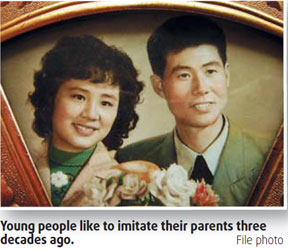
Updated: 2008-11-19 07:56 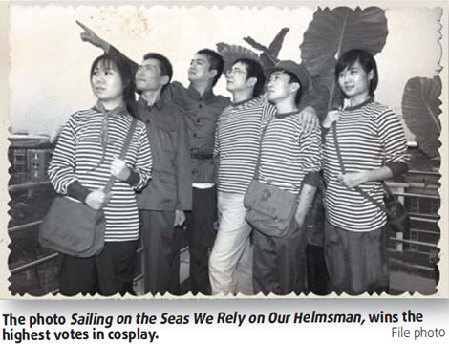 Having your photograph taken in China some 30 years ago was a serious business. One had to sit upright, smile without showing teeth and most of all, the eyes had to shine with patriotism, resolution and hope. While such gestures and expressions have disappeared in modern pictures and have been replaced with the mandatory V for victory finger sign, many young Chinese have been drawn to these old photos and are going to great lengths to imitate their parents. Metroer, a Beijing-based website targeting young white-collar workers, recently held an event, at which young people could restage old photos. Chief organizer Yan Qiao says the idea came from those classic facial expressions, gestures and clothes from the 1960s to 1980s. "They were molded by their times, like cookies," Yan says. The event attracted more than 300 people and participants brought old pictures to a get-together party at a local Beijing bar. Young people showed up in soldiers' uniforms, the Chinese tunic suit initiated by Dr Sun Yat-sen, shirts for marines and student uniforms. A pair of newlyweds asked to have their picture wearing the 1960s revolutionary uniforms. "The retro trend has been popular with many young Chinese recently," according to Ding Ge, a 26-year-old army veteran. Various stage props were also popular, such as red flowers on the soldier's uniforms symbolizing honor, the Little Red Book, a collection of quotations from Chairman Mao Zedong, and even blush powder, according to Li Daming, a make-up director. Li says the party also attracted foreigners. A Western man with blue eyes was dressed in a marines shirt and Li thought he did have some of the style of the old Chinese generation. The photo that won the highest votes was called Sailing on the Seas We Rely on Our Helmsman, which is based on a revolutionary song that compared Mao to a captain of a ship. During the "cultural revolution" (1966-76), people's wedding licenses were printed with quotations of Mao. When the newlyweds went to take pictures, they must chant Mao's quotes and wear Mao badges. Most of the people at the Beijing event belonged to the post-80s generation, and worked in fashion and design. Some were singers, actors, song writers and there were also students. "We are here for nostalgia as well as fun," Ding says. "It's a good chance to feel the emotions of our parents' generation." Going through chaos and hardships, their parents were straight-forward people living a simple life. But Li says today's world is filled with materialism with people wearing various masks. "Cosplay helps people release themselves temporarily from their daily roles in this complicated society," Li says. The second phase of the program will take people back to Beijing in the 1930s and 50s, Yan says.
|
宁都县| 玛多县| 大余县| 新化县| 确山县| 桐庐县| 道真| 革吉县| 资源县| 东乡县| 乌兰察布市| 神池县| 绿春县| 清丰县| 容城县| 安顺市| 上杭县| 甘谷县| 醴陵市| 涿州市| 韶山市| 时尚| 虞城县| 凉城县| 汶川县| 青浦区| 吉隆县| 徐汇区| 金川县| 安新县| 云和县| 黑水县| 正定县| 灵璧县| 宜昌市| 蒲城县| 万荣县| 京山县| 福贡县| 玉龙| 林西县|