CHINA> Focus

|
CHINA> Focus
|
|
A proper house for everyone is the goal
By Wang Ying (China Daily)
Updated: 2008-11-14 07:30 Ye Jinxiang couldn't hide her joy while talking about a phone call she received from Luwan District Housing Security Center on Oct 28. The 52-year-old retiree was told that her application for government low-rent housing aid had been approved, and she would get a monthly subsidy of at least 620 yuan ($90) from November.
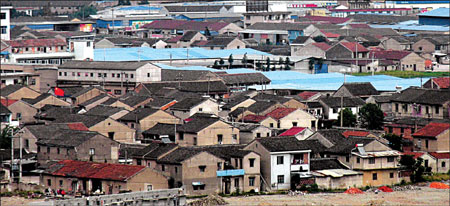
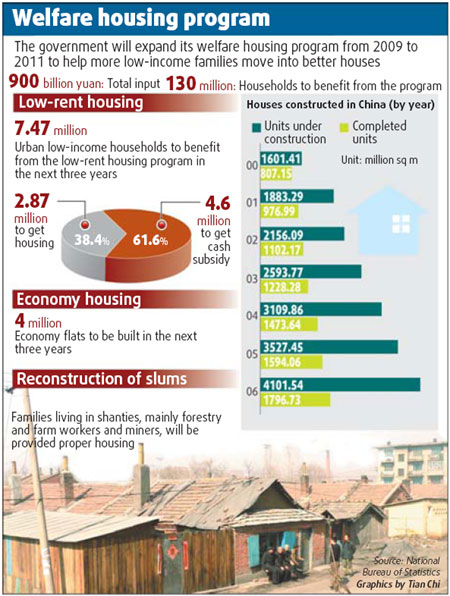
That call meant a world to her, for she and her 19-year-old son can now move out of their dank 9.9-sq-m, second-floor tenement in Shanghai's Ruijin Road into a bigger flat. The room is so small that she often has to spend the night at her mother's house. She returns the next morning to ensure that her son, who attends a university in Shanghai, gets whatever he needs. That's important for her because she wants him to concentrate on his studies. All that will change now that she has been granted the government subsidy. She plans to lease out the room and move to a decent apartment, which she says would be a gift to her son. Ye is one of the 7.47 million urban families that will benefit from the upgraded national welfare housing program, which will get 900 billion from the central government and local governments across the country between 2009 and 2011. The welfare housing plan, listed on top of the country's 4-trillion-yuan stimulus package, will help about 13 million low-income families to move from their average 10-sq-m rooms to bigger and better houses. That will be in addition to the government help that has enabled people like Ye to move into bigger homes. About 4 million housing units will be built and rented out to low-income families in urban areas, Qi Ji, deputy minister of housing and urban-rural development, said on Wednesday. The government will spend 300 billion yuan a year on housing projects, attracting another 600 billion yuan of investment from the cement, iron and steel, construction, home decoration and electrical appliances sectors, and creating 2-3 million jobs. It will help about 2.2 million families of forest and State farm workers, and miners to move from shanties to better houses.
The expanded national welfare-housing program will help stabilize the housing and real estate sectors, which grew by only 1.6 percent last month, the lowest in two years, said Yin Zhongli, a research scholar with the Chinese Academy of Social Sciences. Above all, the program will ensure that a housing safety net is established for the poor both in urban and rural areas, said Li Jingguo, director of research center for urban development and environment under the Chinese Academy of Social Sciences. The real estate sector has contributed largely to urban coffers. That has prompted local governments to neglect the financing of low-rent and smaller flats for years, Li told Sina.com in an online interview on Wednesday. So it's time the governments corrected their policy and stopped thinking about immediate profits. Qi said the housing fund from the central government would mainly help people like Ye, especially those in fund-starved central and western China. Taiyuan, capital of Shanxi province, for instance, had 42,547 families living below the poverty line till June last year. And since the city got just 7.29 million yuan as housing aid in the past four years, only families with a per capita space of 4 sq m or less could get housing aid. But the new program is set to change that. Even Shanghai had a strict threshold, when the low-rent housing program was launched in 2001. Only families with less than 5-sq-m space per member and an average income less than 280 yuan were eligible for assistance. The low-rent level has been lowered several times since then. It is 7 sq m and 800 yuan now, Tang Daping, deputy bureau chief of Housing and Land Administration Bureau of Shanghai's Luwan district, said. By the end of October, 40,124 families were eligible for low-rent housing projects in Shanghai, with 36,971 of them getting monthly subsidies and 2,903 getting low-rent apartments. And since thousands of low-income people had applied for welfare housing, a public draw of lots was arranged on Oct 19 to ensure houses are distributed fairly. |
彩票| 贵港市| 芦山县| 泸定县| 平果县| 濮阳县| 云和县| 宝清县| 南开区| 广元市| 湖南省| 蓬莱市| 苍南县| 阜康市| 陆丰市| 舒兰市| 佛坪县| 鄂州市| 凤城市| 丁青县| 修水县| 贺兰县| 沾化县| 青铜峡市| 肇庆市| 河津市| 南岸区| 托克托县| 威远县| 新巴尔虎左旗| 霸州市| 苍梧县| 曲周县| 新田县| 密云县| 新安县| 香格里拉县| 洪泽县| 新化县| 安多县| 中西区|