CHINA> Beijing Tokyo Forum

|
CHINA> Beijing Tokyo Forum
|
|
Boost for joint efforts in handling disasters
By Zhao Heping (China Daily)
Updated: 2008-09-18 07:57 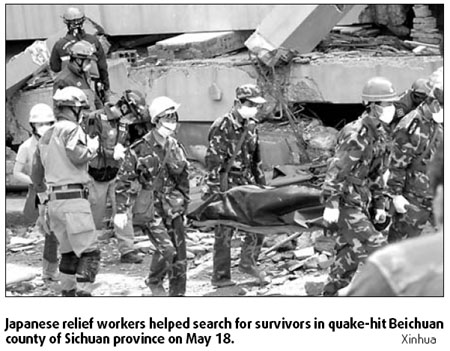 The development of China's earthquake prevention and relief efforts has benefited from international cooperation, especially from long-term exchanges and collaboration with Japan. The two countries are both earthquake-prone and disaster-ridden. In the past few decades, a series of devastating earthquakes such as the Great Hanshin earthquake in Japan in 1995 and the Tangshan earthquake in China's Hebei province in 1976, and the recent May 12 Wenchuan earthquake have inflicted tremendous damage and suffering on the people of the two countries. The serious threat to economic and social development posed by earthquakes and relief efforts to reduce casualties and loss of property are two critical issues facing the two countries. Over the years, China and Japan have been cooperating closely in earthquake relief at various levels including governments, institutes and scientists. The China Earthquake Administration has officially established collaborative relations with the Japan Meteorological Agency, to promote cooperation in earthquake monitoring and forecasting. The administration has launched research with the University of Tokyo and Kyoto University in the areas of disaster prevention and volcanic earthquakes. Scientists from both countries also maintain close contact in the fields of seismology and earthquake engineering. In October, the 14th meeting on earthquake engineering will be held in Beijing. More than 700 Japanese engineering experts will participate, the largest-ever delegation from Japan. This fully reflects the depth and breadth of Sino-Japanese cooperation in earthquake studies. China and Japan have also deepened cooperation in disaster emergency rescue-and-relief. Under the framework of the International Search and Rescue Advisory Group, the two countries have played a constructive role in humanitarian cooperation in the Asia-Pacific region. Both countries have sent rescue teams in recent major disasters and made valuable contributions to disaster relief efforts. To further promote this cooperation, we should first launch research into the Wenchuan earthquake. The May 12 earthquake caused great damage but also left unique and valuable geological and engineering data. Immediately after the disaster, the China Earthquake Administration launched a scientific expedition and the data collection and scientific analysis is still underway. We need to establish a mechanism for regional rescue cooperation as well so that we can strengthen on-site rescue cooperation between the two countries. Once a serious disaster breaks out, we will be able to use geographical advantages and rescue survivors effectively to substantially reduce the impact of the disaster. Sino-Japanese cooperation in emergency rescue capabilities is also crucial for it will help improve earthquake rescue capabilities and enhance emergency management. Over the past three years, the China Earthquake Administration and the Japan International Cooperation Agency have been working on a project on Sino-Japanese cooperation in emergency rescue capacity. Through the implementation of this project, China will further improve emergency response to disaster to effectively mitigate casualties and property losses. The author is the deputy director of China Earthquake Administration |
仁布县| 长顺县| 桃园县| 盖州市| 建昌县| 尚志市| 石景山区| 英超| 改则县| 广州市| 句容市| 台北县| 云浮市| 蓬莱市| 交口县| 惠州市| 常州市| 琼结县| 胶州市| 叶城县| 阳信县| 佛坪县| 罗源县| 革吉县| 连云港市| 吉隆县| 九江市| 和政县| 台前县| 马公市| 乐平市| 安顺市| 永清县| 许昌县| 米脂县| 闻喜县| 莒南县| 吴川市| 西和县| 秦皇岛市| 宜都市|
