CHINA> Focus

|
CHINA> Focus
|
|
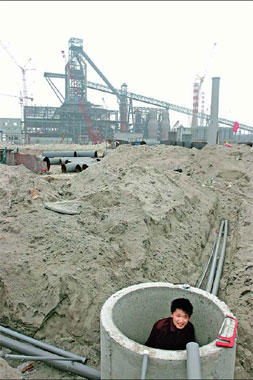
Shougang steels for life beyond Beijing's borders
By Li Jing (China Daily)
Updated: 2008-08-07 10:42 Apart from contributing about 2 billion yuan to Beijing's economic development every year, Shougang also played an important role in the capital's spread. Shijingshan area, which used to be a part of Beijing's outer suburbs of Mentougou, became a district itself with Shougang's growth. In the 1980s, Shougang provided winter heating for Beijingers living to the west of the present-day Chinese Military Museum with its coke-oven gases, according to Wei Zhixing, a veteran worker at the group. "In the 1980s, people living near the plant started to complain about their clothes getting dirty from the black soot when hung out to dry," Wan Zhen, an environmental protection staff member at Shougang, says. Others blamed Shougang for the erosion of the stone lions on the Marco Polo Bridge, aka the Lugou Bridge - because it piled steel residues about 1 km from the bridge, says the spokesman. It was not until the mid-1990s that environmentalists and city planners first imposed restrictions on Shougang's expansion of its Beijing plant, arguing that it was a choice between keeping the capital or keeping the steel capital (that's what Shougang means in Chinese). "Beijing is surrounded by mountain ranges to the west, north and east. The geographical condition is not suitable for the dispersion of pollutants. Shougang's plants are located in the west. The northwest wind in autumn and winter tends to bring the pollutants to the city center, where they stay," says Tian Gang, deputy director of Beijing Research Academy of Environmental Sciences.
On the other hand, Beijing is not an ideal spot for developing iron and steel industry, because it lacks both coal and iron ore. Moreover, it is difficult for Beijing, a city with scarce water resources, to satisfy Shougang's mighty thirst for water, according to Liu Xiaoshi, former director of the Beijing municipal planning commission. Even though Shougang invested more than 200 million yuan every year on environmental protection measures since 1995, all its plans to expand production at the Beijing plant were rejected. As a result, the group's output remained at around 8 million tons a year between 1995 and 2005. But during this period, Shougang's rivals, such as Baosteel in Shanghai and Wuhan Iron and Steel Group, underwent rapid growth and replaced it as the industry leader. "So Shougang Group has long been mulling over an expansion plan outside Beijing, not only out of concern for the environment but also for its own sake," the spokesman says. When Shougang decided to move out of Beijing, many port cities, including some from South China, invited the group, according to the spokesman. But the final choice was Caofeidian, an islet turned into a booming economic development zone in Tangshan, Hebei province. Moving an 8-million-ton steel complex 220 km away was an unprecedented understaking. "It's more like starting a new plant rather than moving an old one," says the spokesman. |
定远县| 岳池县| 大英县| 兴业县| 衡东县| 安庆市| 客服| 德令哈市| 雅安市| 内乡县| 贵港市| 哈尔滨市| 阿荣旗| 墨玉县| 阳春市| 双城市| 冀州市| 中山市| 潜江市| 城步| 淅川县| 图木舒克市| 工布江达县| 虞城县| 德令哈市| 阳信县| 榆中县| 仪征市| 凤庆县| 辽宁省| 遂溪县| 民和| 绥芬河市| 天全县| 交城县| 团风县| 曲水县| 遵化市| 开封县| 北碚区| 吴忠市|